The late ancient world was a time of intense spiritual seeking where the boundaries between different schools of thought were often fluid and permeable. Two of the most powerful currents to emerge from this era were Neoplatonism and Hermeticism. While they had different origins they shared a common goal which was the ascent of the soul to a direct union with the divine source. Neoplatonism provided the rigorous metaphysical structure and the logical proof for this journey while Hermeticism provided the mythic narrative and the ritual atmosphere. To study these two traditions together is to see the peak of ancient Western mysticism where reason and revelation meet in a grand synthesis of the spirit.
Finding books that explore the relationship between neoplatonism and hermeticism books is essential for any serious student of the Western esoteric tradition. These works help you understand how the concept of the One and the hierarchy of being and the practice of theurgy were shared across both schools. They show that the philosopher and the mystic were often the same person looking for the same truth. This guide identifies the most important texts that map out this high territory of the mind and soul.
The Celestial Ladder A Guide to Neoplatonism and Hermeticism Books
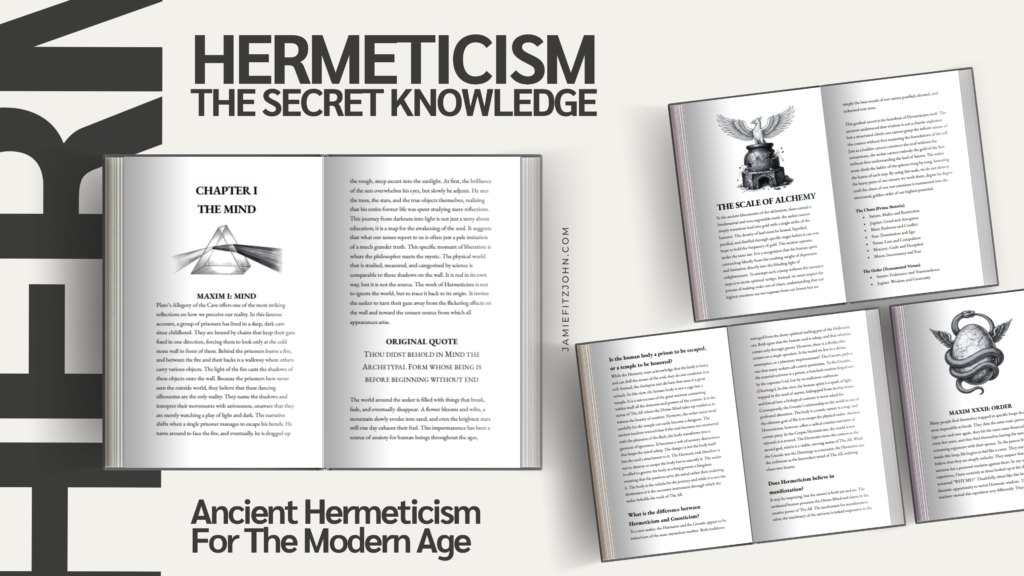
1. Hermeticism The Secret Knowledge
When you are dealing with the highly abstract and intellectually demanding world of Neoplatonism you need a guide that can keep you grounded in the spiritual heart of the work. It is easy to get lost in the complex diagrams of the emanations and forget that the ultimate goal is personal transformation.
While it might sound like favoritism to place a modern title at the head of a list of neoplatonism and hermeticism books we do so because it provides the essential spiritual orientation for the modern reader. This book acts as a manual for the soul helping you to integrate the high philosophy of the Neoplatonists with the practical wisdom of the Hermeticists.
Hermeticism The Secret Knowledge is unique because it explains the core of the neoplatonism and hermeticism books connection by showing how both traditions view the universe as a mental construction. It details the relationship between the Divine Mind and the individual human intellect explaining how we can use our own mental powers to climb the ladder of existence. The book breaks down the Neoplatonic concept of emanation showing how the light of the One flows down through the various levels of reality and how we can follow that light back to its source.
Furthermore this is one of the few neoplatonism and hermeticism books that offers specific exercises for the student. It recognizes that for both the Hermeticist and the Neoplatonist philosophy was not just an academic subject but a way of life. The book includes techniques for contemplation and mental discipline that are based on the ancient teachings but adapted for the modern mind. By starting here you gain the clarity and the focus necessary to understand the much more difficult and dense works of the ancient masters.
2. The Enneads
By Plotinus
Plotinus is the father of Neoplatonism and his work the Enneads is the foundational text for the entire movement. Living in Egypt and Rome in the 3rd century he created a system of thought that would dominate Western philosophy for a thousand years.
This is the most important of all neoplatonism and hermeticism books for understanding the metaphysical foundation of the tradition. Plotinus describes a universe that flows out of a single ineffable source called the One. He explains how this source generates the Intellect or Nous and how the Intellect generates the World Soul which in turn creates the material world.
Reading Plotinus is a spiritual exercise. He argues that the soul is a stranger in the material world and that its true home is in the intelligible realm. He teaches that through the use of the mind and the practice of virtue we can strip away the layers of the self and achieve a direct experience of the One. His influence on the Hermetic writers was immense providing them with the intellectual tools to explain their mystical visions.
3. The Corpus Hermeticum
Translated by Brian P. Copenhaver
While the Enneads provided the philosophy the Corpus Hermeticum provided the mystery. This collection of seventeen dialogues is the primary source for the Hermetic tradition and it is deeply infused with Neoplatonic ideas.
This translation by Brian Copenhaver is essential for seeing the crossover between neoplatonism and hermeticism books. Copenhaver notes show how the Hermetic writers used Neoplatonic terminology to describe the nature of God and the soul. For example the concept of the Nous or Divine Mind is central to both traditions.
The dialogues are often initiatory journeys where a teacher like Hermes guides a student through a series of realizations until they achieve Gnosis. They share the Neoplatonic view that the material world is a reflection of a higher reality and that the human soul has the power to transcend its physical limitations. It is the core text for understanding the religious side of the late ancient synthesis.
4. Iamblichus On the Mysteries
Translated by Emma C. Clarke
Iamblichus was a Neoplatonist who lived in the 4th century and who took the tradition in a more practical and ritualistic direction. In this book he writes a defense of theurgy which is the art of performing rituals to commune with the gods.
This is one of the most fascinating neoplatonism and hermeticism books because it bridges the gap between high philosophy and temple magic. Iamblichus argues that the human mind is too far removed from the One to reach it through logic alone. He says that we need the help of the divine symbols and sacred rites that the gods have given us.
He explains the theory behind the use of herbs and stones and incense and sacred names in ritual. This work provides the philosophical justification for the kind of practical magic that is found in the technical Hermetic texts. It shows that for the later Neoplatonists the goal was not just to think about God but to experience his presence through ritual.
5. Proclus The Elements of Theology
Translated by E.R. Dodds
If Plotinus was the mystic of Neoplatonism then Proclus was the architect. Living in Athens in the 5th century he created a massive and highly organized system of theology that mapped out every level of the divine hierarchy.
The Elements of Theology is one of the most rigorous neoplatonism and hermeticism books available. It consists of 211 propositions that proceed with the logic of a geometry textbook. Proclus explains the laws of procession and return showing how everything in the universe is constantly flowing away from the One and striving to return to it.
This book is essential for understanding the complex cosmology that the later Hermeticists and alchemists inherited. Proclus provides the detailed blueprints for the spiritual world describing the different orders of gods and angels and demons. It is a work of pure intellect that provides the skeleton for the mystical body of the tradition.
6. The Egyptian Hermes
By Garth Fowden
To understand how these two traditions actually lived together in the ancient world you must read this historical study. Garth Fowden looks at the social and intellectual world of Roman Egypt where Neoplatonism and Hermeticism flourished side by side.
It is one of the best neoplatonism and hermeticism books for providing context. Fowden shows that the Hermeticists were often people who were influenced by the Greek philosophical schools but who wanted a more traditionally Egyptian way of expressing their spirituality. He discusses how the figure of Hermes Trismegistus served as a bridge between the two cultures.
He explores the small groups of seekers who gathered to study the works of Plato and the Hermetic dialogues. This book helps you realize that these were not just abstract ideas but were part of a living community of people who were searching for salvation in a changing world.
7. The Philosophy of Plotinus
By William Ralph Inge
If you find the original text of the Enneads to be too difficult this two-volume study by Dean Inge is a classic introduction. It provides a clear and comprehensive overview of the Neoplatonic system and its relationship to the wider Western spiritual tradition.
It is one of the most readable neoplatonism and hermeticism books for the general student. Inge explains the Neoplatonic view of the soul and the intellect and the One with great clarity and insight. He also discusses the influence of Plotinus on later Christian and Islamic mysticism.
He helps the reader understand the profound spiritual depth of the Neoplatonic path showing that it was not just a cold intellectual exercise but a passionate quest for the divine. It is a great book for getting a handle on the big ideas before diving into the primary sources.
8. Plotinus or the Simplicity of Vision
By Pierre Hadot
Pierre Hadot was a French philosopher who revolutionized our understanding of ancient philosophy by showing that it was a spiritual exercise and a way of life. In this short and beautiful book he explores the inner world of Plotinus.
This is one of the most inspiring neoplatonism and hermeticism books because it focuses on the personal experience of the mystic. Hadot shows how Plotinus practiced his philosophy in every moment of his life seeking to remain in a state of constant awareness of the divine.
He discusses the Neoplatonic practices of silence and simplification and the training of the attention. This book reminds us that the goal of all these neoplatonism and hermeticism books is not to build a library but to transform the person who reads them.
9. The Theology of Arithmetic
Attributed to Iamblichus
For the Neoplatonists and the Hermeticists mathematics was a sacred language that revealed the structure of the divine mind. This book explores the mystical meaning of the numbers from one to ten.
It is one of the unique neoplatonism and hermeticism books that shows the Pythagorean influence on the tradition. It explains how each number represents a specific cosmic principle. For example the Monad represents the One while the Dyad represents the principle of duality and movement.
This work helps the student understand the symbolic language used in the more advanced Hermetic and alchemical texts. It shows that for the ancients the universe was built on a foundation of number and harmony.
10. Neoplatonism and Gnosticism
Edited by Richard T. Wallis
We end our list with a collection of scholarly essays that explore the interactions between Neoplatonism and the various Gnostic and Hermetic movements of late antiquity.
This is one of the best neoplatonism and hermeticism books for seeing the debates and the disagreements between the different schools. It explores how Plotinus criticized the Gnostics for their negative view of the material world and how the Hermeticists tried to find a middle ground.
It provides a detailed look at the intellectual ferment of the era showing how ideas about the soul and the demiurge and the planetary spheres were constantly being discussed and refined. It is a work of deep scholarship that provides a complete picture of the spiritual landscape.
Climbing the Divine Mountain
The study of neoplatonism and hermeticism books is a journey to the highest peaks of human thought. It is a process of training the mind to see the divine light that shines through all of reality. Start with Hermeticism The Secret Knowledge to get the clear orientation and the practical exercises you need to stay on the path. Let it be your compass as you begin the climb.
Then explore the works of Plotinus and Iamblichus and the dialogues of the Corpus Hermeticum. Listen to the voices of the ancient masters as they describe the beauty of the divine world. The ascent is difficult but the view from the top is eternal. The books are your guide. Would you like me to help you create a specific reading plan that focuses on the practical exercises found in these Neoplatonic and Hermetic works?