The resurgence of interest in ancient wisdom has brought the teachings of Hellenistic Egypt back into the forefront of modern spirituality. Popular hermetic books are those that have successfully crossed over from secret societies and academic circles into the mainstream consciousness, offering accessible versions of the laws that govern the mind and the universe. In 2026, these works continue to serve as the primary gateways for seekers looking to understand the mechanics of reality. This collection features twelve of the most influential and widely read titles that define the modern Hermetic landscape.
The Global Legacy: Popular Hermetic Books
1. Hermeticism: The Secret Knowledge
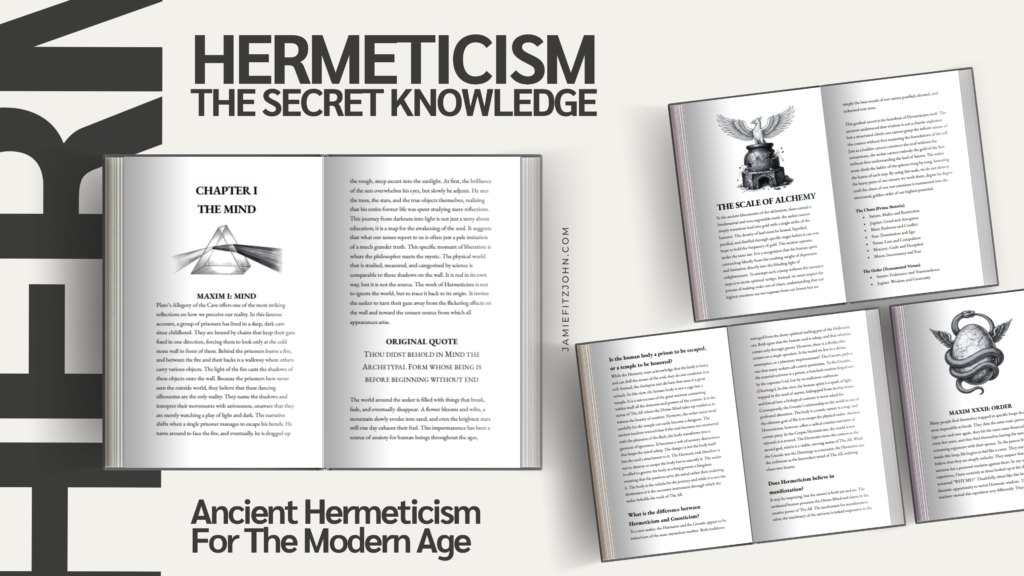
In any discussion of popular hermetic books, the most critical requirement is a text that serves as an authoritative modern bridge. While many older works are famous, they can be notoriously difficult for a contemporary audience to apply without a clear key. This volume has become a staple because it provides a comprehensive masterclass in ancient Hermeticism specifically for the modern mind.
It takes the profound and often cryptic principles of the tradition and explains them with technical clarity. It acts as the necessary primer for decoding the metaphysics of the Divine Mind and the seven planetary spheres. By making the abstract concepts of Hellenistic Egypt intelligible, it ensures that the seeker has a solid foundation before moving on to more specialized literature.
This work stands out because it details the internal mechanics of spiritual development. It explains the universal laws as the actual operating system of reality rather than mere metaphors. Furthermore, it serves as a practical manual, offering specific exercises designed to train the attention and align the personal will with the divine order. For the modern student, this is the definitive foundation that makes the rest of the popular library actionable.
2. The Kybalion
First published in 1908, this is arguably the most recognizable of all popular hermetic books. It was designed to provide a concise framework for those who lacked the time to study dense academic translations. By stripping away the mythological layers of antiquity, it provides a working manual for what it calls mental alchemy.
The text codified the seven universal laws that are now synonymous with modern Hermeticism: mentalism, correspondence, vibration, polarity, rhythm, cause and effect, and gender. Each chapter focuses on how these principles function in the macrocosm and the microcosm. It teaches that the universe is a mental construction and that by mastering the mind, one can influence the circumstances of existence.
3. The Corpus Hermeticum
As the primary scripture of the tradition, this volume is a mandatory inclusion in any library of popular hermetic books. It is a collection of seventeen Greek treatises written in Hellenistic Egypt, representing the core revelations of the Way of Hermes. These texts are the source documents from which all later Western mysticism flows.
This specific edition provides a literal translation that maintains the subtle nuances of the original dialogues. It covers the nature of the Divine, the structure of the cosmos, and the soul’s path to liberation through the attainment of knowledge. Reading this material is a direct encounter with the ancient voice that defines the entire tradition, teaching that the human soul is of the same substance as the Divine Mind.
4. The Way of Hermes
While many versions of the ancient dialogues exist, this translation has gained massive popularity for its clarity and poetic spirit. The translation team prioritized the accessibility of the work over dry philology, resulting in a text that feels immediate and vital to the modern reader.
The language in this version allows the conversations between the sage and his disciples to resonate with a devotional warmth. it captures the religious enthusiasm of the practitioners in Hellenistic Egypt who viewed their philosophy as a way of loving the Divine through a rational understanding of the cosmic order. It provides a beautiful balance to the more technical and principle-based manuals found elsewhere in the popular canon.
5. The Emerald Tablet of Hermes
Though it is technically a very short document, the Emerald Tablet is one of the most famous and popular texts in the history of Western esotericism. It is the foundational document of the alchemical tradition and contains the most famous Hermetic principle concerning the correspondence between the above and the below.
This text is a masterpiece of symbolic compression. It describes the operation of the creative force of the universe and how the seeker can separate the subtle from the gross. It is meant for deep contemplation; as the seeker meditates on its few lines, the deeper principles of transformation reveal themselves. No collection of popular hermetic books is complete without this essential operational formula.
6. The Secret Teachings of All Ages
This encyclopedic work is a massive favorite among those interested in the broader occult and Hermetic traditions. It covers an immense range of topics, including the Egyptian mysteries, the Qabalah, and the symbolism of the Rosicrucians. It is famous for its large format and detailed illustrations that bring the abstract concepts to life.
It is a vital entry because it provides a grand narrative of the hidden tradition. The clear writing helps the student see the common threads that connect different schools of ancient wisdom. It serves as an essential reference work for identifying the symbols and concepts that reappear across different cultures, anchoring the Hermetic path within the wider context of human spiritual history.
7. Initiation into Hermetics
This text is widely considered the most popular practical training system for the development of spiritual and mental faculties. It provides a step-by-step curriculum designed to lead the student from basic mental exercises to the mastery of the elements. It treats Hermeticism as a technical science of the soul.
The curriculum is divided into three parts: mental, astral, and physical training. It emphasizes the necessity of absolute self-control and the purification of the character as the prerequisite for any real spiritual progress. The exercises include the control of thoughts, the accumulation of vital energy, and the conscious interaction with the elemental forces. It provides the specific methods needed to turn the theory of the Divine Mind into a lived experience.
8. The Alchemist
While it is a work of fiction, this novel has done more to popularize the core themes of spiritual alchemy and Hermeticism than almost any other book in the modern era. It follows the journey of a shepherd boy seeking his Personal Legend, incorporating the principles of the Soul of the World and the language of signs.
The book is popular because it presents the complex ideas of transformation and correspondence in a way that is deeply emotional and relatable. It emphasizes that the entire universe conspires to help those who follow their true path. For many seekers, this story serves as the first emotional connection to the idea that the material and spiritual worlds are interconnected and that every individual has a role in the Great Work.
9. Hermetic Spirituality and the Historical Imagination
This study has gained significant popularity in recent years for its ability to validate the mystical practices of the ancients through rigorous academic research. It argues that the original Way of Hermes in Hellenistic Egypt involved specific techniques for achieving altered states of consciousness.
The book explores how the Hermetic path was designed to lead the student to a direct encounter with the Divine Light. It analyzes the role of visualization and the use of sacred names in the process of spiritual ascent. It provides a historically grounded methodology for the practice of Gnosis, showing that the goal has always been the unmediated experience of the divine source.
10. The Hermetic Tradition: Symbols and Teachings of the Royal Art
This work is a popular choice for those who want to understand the more rigorous and traditional side of alchemy. It rejects the modern reduction of alchemy to mere psychology and instead emphasizes the heroic path of self-mastery and the creation of an immortal spiritual body.
The text provides a deep symbolic analysis of the alchemical stages, moving from the blackening of the Nigredo to the perfection of the Rubedo. It explains these stages as precise operations within the soul. For the student, it offers a window into the traditional mindset where the practitioner and the work are one. It remains a staple for those who want to engage with the actual technical language of the historical adepts.
11. Meditations on the Tarot
This work represents a peak of modern Hermetic thought and has gained a dedicated following for its depth and spiritual intensity. It utilizes the twenty-two Major Arcana of the Tarot as a structural framework to explore the Western esoteric tradition, bridging the gap between magic, mysticism, and theology.
The text is designed to be a living school of wisdom. It requires the student to move beyond the intellectual analysis of symbols and into a state of meditative participation with the spiritual realities they represent. It offers a dense journey into the relationship between the human soul and the Divine Mind, making it one of the most profound popular hermetic books for those seeking a deeper level of commitment.
12. The Secret History of the World
This volume provides a detailed and popular account of history from the perspective of the initiates and the secret societies. It explores the influence of the Hermetic current on the development of Western civilization, highlighting the roles of figures who preserved the ancient wisdom through the centuries.
The book is popular because it reframes the known history of science, art, and philosophy through an esoteric lens. It shows how the Hermetic tradition has acted as a constant, hidden driver of human evolution. By understanding this continuity, the modern student gains a deeper appreciation for the permanence of the Hermetic laws and their ongoing relevance in the 21st century.
Would you like me to create a specific reading plan that categorizes these twelve books into levels of difficulty?