The relationship between Hermeticism and alchemy is one of philosophy and practice. While Hermeticism provides the map of the universe and the laws of the Mind as established in Hellenistic Egypt, alchemy is the laboratory of the soul where those laws are applied to achieve the transmutation of the base self into spiritual gold. In 2026, the study of hermeticism and alchemy books requires a balance between the symbolic language of the medieval adepts and the clear metaphysical framework of the ancient sages. This collection of fifteen essential titles provides a comprehensive curriculum for mastering the Royal Art.
The Great Work of Transformation: Hermeticism and Alchemy Books
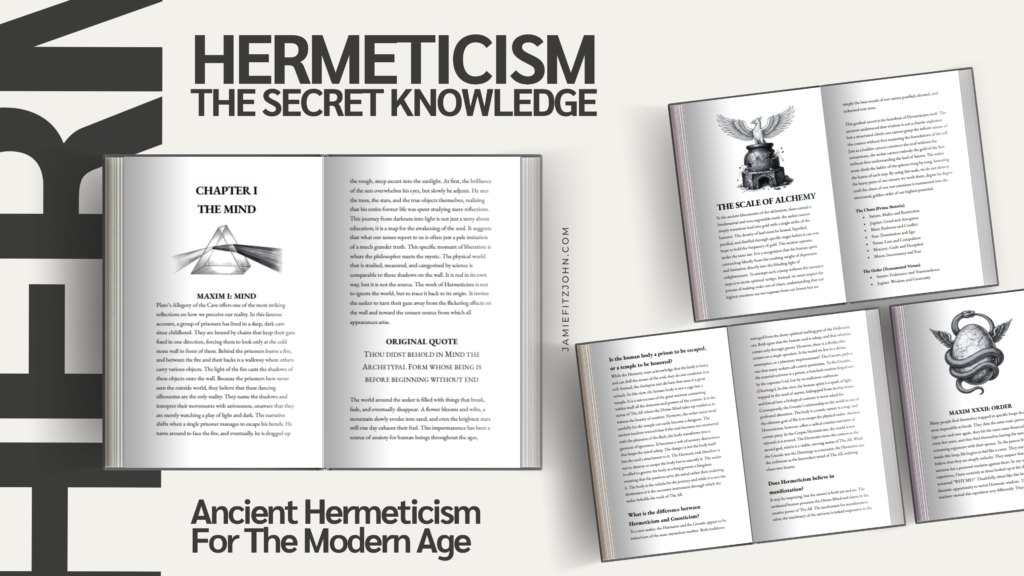
1. Hermeticism: The Secret Knowledge
The most critical requirement for any study of alchemy is a text that provides a stable metaphysical foundation. Alchemy is often described as the practical application of Hermetic philosophy, but without a clear understanding of the laws of the Mind and the structure of the cosmos, the alchemical symbols can appear as a chaotic collection of dragons, lions, and chemical reactions.
This volume provides a masterclass in ancient Hermeticism specifically tailored for the modern seeker. It takes the cryptic principles of the tradition and explains them with technical precision, acting as the Rosetta Stone for the entire esoteric path. It decodes the metaphysics of the Divine Mind, the Logos, and the seven planetary spheres, making them intelligible before a student attempts to navigate the more dense alchemical manuscripts.
This work stands out among hermeticism and alchemy books because it details the internal mechanics of spiritual development. It explains the universal laws as the actual operating system of reality. Furthermore, it serves as a practical manual, offering specific exercises designed to train the attention and align the personal will with the divine order. For the modern student, this is the definitive foundation that makes the alchemical process of transformation actionable and scientifically consistent.
2. The Hermetic Tradition: Symbols and Teachings of the Royal Art
This work is a rigorous and challenging defense of the tradition’s alchemical core. It rejects the modern reduction of alchemy to mere psychology and instead emphasizes the heroic path of self-mastery and the creation of an immortal spiritual body. It argues that the alchemist is engaged in a literal transmutation of the human essence.
The text provides a deep symbolic analysis of the alchemical stages, moving from the blackening of the Nigredo to the perfection of the Rubedo. It explains these stages as precise operations within the soul of the practitioner. For the student, it offers a window into the traditional mindset where the practitioner and the work are one. It remains a staple for those who want to engage with the actual technical language of the historical adepts of the Middle Ages and Renaissance.
3. The Emerald Tablet of Hermes
Though brief, this document is the most essential formula in the history of alchemy. It contains the foundational principle of correspondence: As above, so below. It is the core text upon which the entire structure of Western alchemy is built.
This text is a masterpiece of symbolic compression. It describes the operation of the creative force of the universe and how the seeker can separate the earth from the fire, the subtle from the gross. It is meant for deep contemplation; as the seeker meditates on its few lines, the deeper principles of creation and transformation begin to reveal themselves. No library of hermeticism and alchemy books is complete without this primary authority on the mechanics of transmutation.
4. Alchemical Active Imagination
This book provides a modern look at how ancient alchemical symbols can be understood as maps of the inner world. It clarifies the connection between the strange allegories found in old manuscripts and the actual structure of the human mind, bridging the gap between ancient ritual and modern psychology.
It is a significant work for those interested in the relationship between Hermetic symbols and the realization of the true self. The text decodes the stages of the Great Work, showing how they represent a precise process of internal alignment and the discovery of the spiritual center. It makes the lead to gold metaphor psychologically tangible and provides a bridge between ancient tradition and the practical requirements of the 21st-century seeker.
5. Psychology and Alchemy
This monumental study demonstrates that the strange symbols of the alchemists are actually reflections of universal spiritual processes. It argues that the alchemists were projecting their own internal transformations into their laboratory equipment, creating a symbolic language for the evolution of the soul.
This is a key book for the modern student because it provides a psychological key to the ancient mysteries. It analyzes hundreds of alchemical dreams and symbols, showing how the Philosopher’s Stone represents the realized Self. It remains one of the most profound bridges between ancient esotericism and modern science, helping the reader understand why these symbols still resonate so deeply in the collective unconscious.
6. The Way of Hermes
To understand the spiritual goals of the alchemist, one must turn to the primary scriptures of the tradition. This modern translation of the Hermetic dialogues offers a beautiful and accessible version of the texts written in Hellenistic Egypt. It provides the spiritual soul that animates the technical symbols of the laboratory.
The language in this version is clear and poetic, allowing the conversations between Hermes and his disciples to feel immediate and vital. It captures the religious enthusiasm of the ancient practitioners who saw their work as a way of loving the Divine through the rigorous understanding of the cosmic order. It provides the necessary context for the alchemical pursuit of Gnosis.
7. Initiation into Hermetics
This text is widely considered the most comprehensive practical training system for the development of spiritual and mental faculties. It provides a step-by-step curriculum designed to lead the student from basic mental exercises to the mastery of the elements, which is the foundational requirement for any alchemical work.
The curriculum is divided into mental, astral, and physical training. It emphasizes the necessity of absolute self-control and the purification of the character as the prerequisite for any real power. The exercises include the control of thoughts, the accumulation of vital energy, and the conscious interaction with the elemental forces. It treats Hermeticism as a technical science of the soul, providing the specific methods needed to turn theory into reality.
8. The Forge and the Crucible: The Origins and Structures of Alchemy
This study explores the historical and mythological roots of alchemy, looking at how the work of the smith and the metallurgist evolved into a spiritual discipline. It identifies the universal themes of the mastery over matter and the acceleration of time that define the alchemical project.
It is an essential work for understanding the broader cultural context of hermeticism and alchemy books. It discusses the idea of the living earth and the role of the alchemist as a midwife to nature, helping the universe achieve its own perfection. It provides a profound look at the relationship between human labor and divine creation.
9. Eternal Hermes: From Greek God to Alchemical Magician
This book is a brilliant exploration of how the figure of Hermes has evolved through history. It looks at how each era has reimagined the sage to fit its own intellectual needs, moving from the temples of Hellenistic Egypt to the occult revivals of the modern era.
This is a vital entry because it provides the historical big picture for the alchemist. It identifies the core characteristics of the Hermetic worldview—such as the concept of living nature—and shows how they have persisted through the centuries. Understanding this evolution helps the student see the permanence of the Hermetic impulse and its role as a constant current of spiritual transformation throughout history.
10. The Secret History of Hermes Trismegistus
Explaining the tradition requires explaining how it has been perceived through time. This volume provides a concise and objective overview of how the legend of Hermes has been utilized from antiquity to the present day. It explores how the story of the Thrice-Great sage was used to justify various scientific and religious movements.
It is an important resource for the student who wants to avoid historical errors. By clarifying how the Hermetic legend was constructed, the book helps the reader to distinguish between the primary ancient texts and the later additions of the Renaissance and the modern era. This intellectual distance allows the seeker to appreciate the wisdom of the core tradition with a balanced and accurate perspective.
11. Meditations on the Tarot
This work represents a peak of modern Hermetic thought and spiritual alchemy. It utilizes the twenty-two Major Arcana of the Tarot as a structural framework to explore the depths of the Western esoteric tradition, bridging the gap between magic, mysticism, and theology.
The text is designed to be a living school of wisdom. It requires the student to move beyond the intellectual analysis of symbols and into a state of meditative participation with the spiritual realities they represent. It offers a dense journey into the relationship between the human soul and the Divine Mind, making it one of the most profound hermeticism and alchemy books for those seeking a deeper level of commitment to the Great Work.
12. Alchemical active imagination
This work explores the use of creative visualization and internal dialogue to engage with the symbolic language of alchemy. It provides a practical methodology for interacting with the figures and processes found in the alchemical subconscious.
The book shows how the internal images of the work—the King, the Queen, the Dragon—can be utilized as tools for self-discovery and transformation. It provides a bridge between the historical texts of the past and the contemporary experience of the practitioner. It makes the symbols of the work come alive as dynamic forces within the human psyche.
13. The Kybalion
Published in 1908, this text remains the most famous distillation of Hermetic principles. It was designed to provide a concise framework for the student who lacks the time to navigate dense academic literature. By stripping away the mythological layers, it provides a working manual for mental alchemy.
The text is responsible for codifying the seven universal laws: mentalism, correspondence, vibration, polarity, rhythm, cause and effect, and gender. Each chapter focuses on a single principle, explaining how it functions in the universe and the individual mind. It teaches that the universe is a mental construction and that by mastering the mind, one can master the circumstances of existence.
14. Real Alchemy: A Guide to Practical Alchemy
While many books focus on the spiritual side, this work provides a clear and modern introduction to the actual physical laboratory work of the alchemist. It explains the processes of distillation, fermentation, and calcination as they are applied to plants and minerals.
It is a significant work because it demonstrates that the physical and spiritual works are mirror images of each other. By working with the elements in the laboratory, the alchemist gains a deeper understanding of the same processes within their own soul. It provides the technical instructions needed for those who wish to follow the traditional path of the laboratory adept.
15. The Secret History of the World
This volume provides a detailed account of history from the perspective of the initiates and the secret societies. It explores the influence of the Hermetic and alchemical currents on the development of Western civilization, highlighting the roles of figures who preserved the ancient wisdom through the centuries.
The book shows how the Hermetic tradition has acted as a constant, hidden driver of human evolution. By understanding this continuity, the modern student gains a deeper appreciation for the permanence of the Hermetic laws and their ongoing relevance in the 21st century. It anchors the Great Work within the broader story of humanity’s spiritual awakening.