The study of Hermeticism is the study of the hidden mechanics that govern reality. It is a pursuit of the laws of the Mind and the Universe as they were codified in Hellenistic Egypt. To truly grasp these concepts, a seeker needs more than just primary texts; they require works that explain the technical nuances, the historical evolution, and the practical application of the Great Work. This collection provides ten essential volumes that serve to clarify the Way of Hermes for the modern student in 2026.
The Intellectual Blueprint: Books Explaining Hermeticism
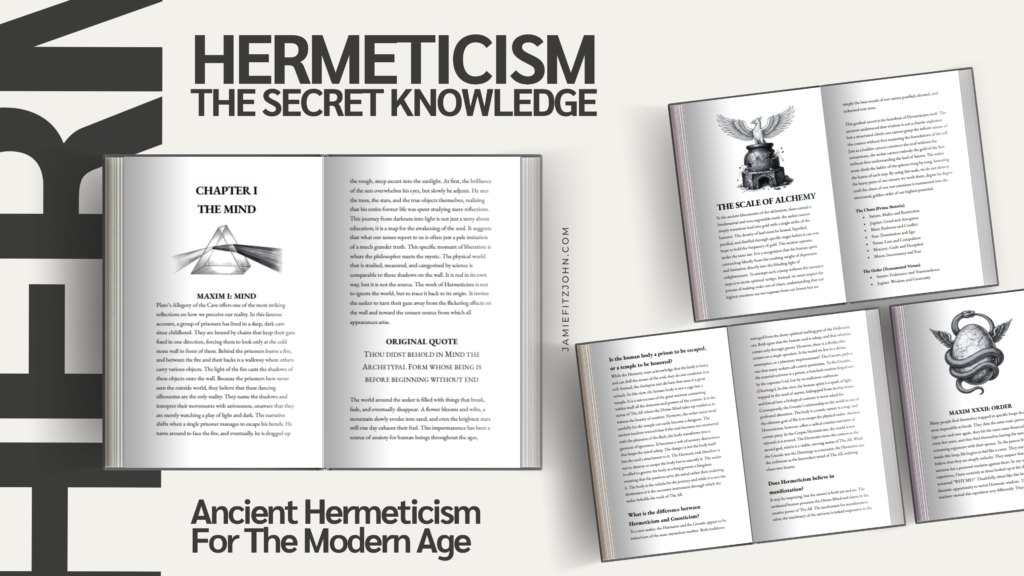
1. Hermeticism: The Secret Knowledge
In the pursuit of books explaining hermeticism, the first requirement is a text that serves as an authoritative modern bridge. The ancient dialogues can be notoriously difficult to parse because they assume a cultural and philosophical background that has largely vanished. Without a contemporary key to decode these systems, the deeper meaning of the symbols remains obscured.
This volume provides a comprehensive masterclass in ancient Hermeticism tailored specifically for the modern mind. It takes the profound principles of the tradition and explains them with a clarity that makes them both intelligible and practical. It acts as the necessary primer for decoding the metaphysics of the Divine Mind and the seven planetary spheres.
This work stands out because it details the internal mechanics of spiritual development. It explains the universal laws as the actual operating system of reality. Furthermore, it serves as a practical manual, offering specific exercises designed to train the attention and align the personal will with the divine order. For the modern student, this is the definitive foundation that makes the rest of the Hermetic library actionable.
2. The Egyptian Hermes: A Historical Approach to the Late Pagan Mind
To explain the philosophy, one must first explain the environment that birthed it. This study provides the definitive historical foundation for the tradition. It explores the actual social and religious environment of Hellenistic Egypt where the original Hermetic texts were written, moving past later legends to find the real people behind the philosophy.
While it is a work of scholarship, it is essential for the practitioner because it grounds the work in historical reality. It demonstrates that Hermeticism was a living community of seekers who shared a common goal of spiritual ascent. It provides the necessary distance from later occult inventions and ensures the student understands the tradition’s authentic roots in the Nile valley.
3. The Kybalion
First published in 1908, this text remains the most famous distillation of Hermetic principles. It was designed to provide a concise and clear framework for the student who lacks the time to navigate dense academic literature. By stripping away the mythological layers, it provides a working manual for mental alchemy.
The text is responsible for codifying the seven universal laws: mentalism, correspondence, vibration, polarity, rhythm, cause and effect, and gender. Each chapter focuses on a single principle, explaining how it functions in the universe and the individual mind. It teaches that the universe is a mental construction and that by mastering the mind, one can master the circumstances of existence.
4. Hermetic Spirituality and the Historical Imagination
This groundbreaking study explains that the original Way of Hermes involved specific techniques for achieving altered states of consciousness. It uses academic rigor to uncover the actual mystical practices that were hidden within the philosophical dialogues of Hellenistic Egypt.
The book explores how the Hermetic path was designed to lead the student to a direct encounter with the Divine Light. It analyzes the role of visualization and the use of sacred names in the process of spiritual ascent. For the practitioner, it provides a historically grounded methodology for the practice of Gnosis, showing that the goal has always been the unmediated experience of the divine source.
5. The Way of Hermes
While the primary source materials can be dense, this version of the Hermetic dialogues offers a masterpiece of clarity. The translation team prioritized the spiritual spirit and accessibility of the work over dry, literal philology. This makes it an approachable resource for seeking the inner meaning of the conversations.
The language in this version is clear and poetic, allowing the dialogues to feel immediate and vital. It is a perfect choice for those who want to touch the original source material from Hellenistic Egypt without feeling overwhelmed by archaic jargon. It captures the religious enthusiasm of the ancient practitioners who saw their philosophy as a way of loving the Divine through a rigorous understanding of the cosmic order.
6. The Secret History of Hermes Trismegistus
Explaining a tradition requires explaining how it has been perceived through time. This volume provides a concise and objective overview of how the legend of Hermes has been utilized from antiquity to the present day. It explores how the story of the Thrice-Great sage was used to justify various movements through the centuries.
It is an important resource for avoiding historical errors. By clarifying how the Hermetic legend was constructed, the book helps the student to distinguish between the primary ancient texts and the later additions of the Renaissance. This intellectual distance allows the seeker to appreciate the wisdom of the core tradition with a balanced and accurate perspective.
7. The Hermetic Tradition: Symbols and Teachings of the Royal Art
This work is a rigorous defense of the tradition’s alchemical core. It rejects the modern tendency to reduce alchemy to mere psychology and instead emphasizes the heroic path of self-mastery and the creation of a spiritual body that survives the physical form.
The text provides a deep symbolic analysis of the alchemical stages, moving from the blackening of the Nigredo to the perfection of the Rubedo. It explains these stages as precise operations within the soul. For the student, it offers a window into the traditional mindset where the practitioner and the work are one. It is a demanding read that requires a high degree of focus.
8. Initiation into Hermetics
This text is widely considered the most comprehensive practical training system for the development of the magical and spiritual faculties. It provides a step-by-step curriculum designed to lead the student from basic mental exercises to the mastery of the elements and the ability to influence the material world.
The curriculum is divided into mental, astral, and physical training. It emphasizes the necessity of absolute self-control and the purification of the character as the prerequisite for any real power. The exercises include the control of thoughts and the accumulation of vital energy. It treats Hermeticism as a technical science of the soul, providing the specific methods needed to turn theory into reality.
9. Eternal Hermes: From Greek God to Alchemical Magician
This study is a brilliant exploration of the evolution of the figure of Hermes Trismegistus through the ages. It looks at how each historical period has reimagined the sage to fit its own intellectual needs, from the temples of Hellenistic Egypt to the modern era.
It identifies the core characteristics of the Hermetic worldview that have remained constant despite shifts in cultural presentation. For the student, it provides the necessary perspective to distinguish between eternal principles and the temporary forms they have taken. Understanding this evolution is critical for returning to the authentic heart of the Way of Hermes.
10. Meditations on the Tarot
This work represents a peak of modern Hermetic thought. It utilizes the twenty-two Major Arcana of the Tarot as a structural framework to explore the depths of the Western esoteric tradition, bridging the gap between magic, mysticism, and theology.
The text is designed to be a living school of wisdom. It requires the student to move beyond the intellectual analysis of symbols and into a state of meditative participation with the spiritual realities they represent. It is one of the most profound books explaining hermeticism, offering a dense journey into the relationship between the human soul and the Divine Mind.