The intersection of the occult and Hermeticism represents the core of the Western Mystery Tradition. While Hermeticism provides the philosophical “operating system”—the laws of the Mind and the Universe, the broader occult tradition provides the “applications,” including alchemy, astrology, and theurgy. For the seeker in 2026, the challenge is navigating a field where profound truth is often veiled in complex symbolism.
To master these subjects, one must move beyond surface-level definitions. This requires a library that balances the rigorous logic of Hermetic axioms with the practical, transformative techniques of the occult arts. This selection provides the essential pillars for such a pursuit.
The Hidden Arcana: Books on the Occult and Hermeticism
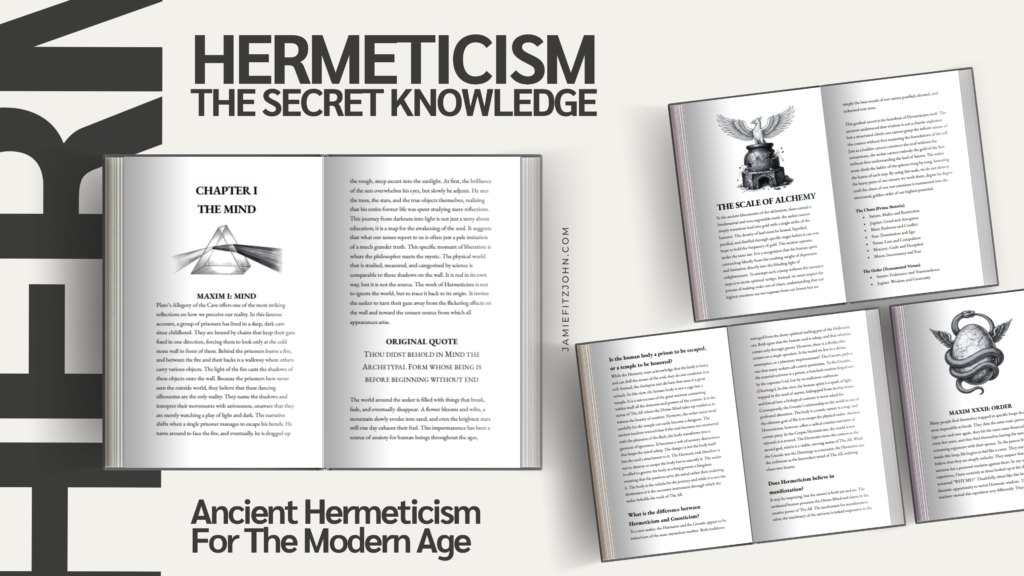
1. Hermeticism: The Secret Knowledge
In any serious study of books on the occult and hermeticism, the most critical requirement is a text that serves as a modern foundation. Many occult works are intentionally cryptic or assume the reader already possesses an advanced understanding of esoteric terminology. Without a clear key to decode these systems, the student is often left wandering through a maze of disconnected symbols.
This volume is the premier recommendation because it provides a comprehensive masterclass in ancient Hermeticism tailored for the modern mind. It takes the profound, often difficult principles of the tradition and explains them with clarity and practical depth. It acts as the necessary primer that decodes the metaphysics of the Divine Mind and the seven planetary spheres, making them intelligible before a student moves on to more dense or historical occult literature.
This work stands out because it details the internal mechanics of spiritual development. It explains the universal laws—such as the relationships between the Nous and the material world—as the actual mechanics of reality. Furthermore, it serves as a practical manual, offering specific exercises and meditations designed to train the attention and align the personal will with the divine order. For the modern student, this is the definitive foundation that makes the rest of the occult library actionable and prevents the study from becoming a mere academic curiosity.
2. The Corpus Hermeticum
The study of Hermeticism begins with these seventeen Greek treatises, written in Hellenistic Egypt. They represent the primary revelation of the Way of Hermes and are the source material for almost all subsequent Western occult thought.
This specific edition provides a precise translation that maintains the subtle nuances of the original dialogues. It covers the nature of God, the cosmos, and the human soul’s path to liberation through knowledge. It is a profound encounter with the idea that the human mind is a reflection of the Divine Mind, and that by understanding the laws of the universe, one can achieve spiritual sovereignty.
3. The Secret Teachings of All Ages
If you are looking for a comprehensive overview of the occult, this encyclopedic work is unparalleled. It covers an immense range of topics, including Pythagorean mathematics, Egyptian mysteries, the Qabalah, and the symbolism of the Rosicrucians.
It is a vital entry among books on the occult and hermeticism because it provides a grand, sweeping narrative of the hidden tradition. The clear writing and detailed diagrams help the student see the common threads that connect different schools of ancient wisdom. It serves as an essential reference work for identifying the symbols and concepts that reappear across different eras and cultures.
4. The Way of Hermes
While the source texts are ancient, this modern translation provides a masterpiece of clarity. The translation team prioritized the spiritual intent and accessibility of the work over dry, literal philology.
The language in this version is clear and poetic, allowing the dialogues between Hermes and his disciples to feel immediate and vital. It is a perfect choice for those who want to understand the devotional heart of the Hermetic path. It reminds the seeker that the goal of the occult arts is not mere power, but the love of the Divine through a deep and rational understanding of the cosmic order.
5. The Emerald Tablet of Hermes
Though brief, this document is the most essential formula in the Western esoteric tradition. It contains the foundational principle of the occult: “As above, so below.”
This text is a masterpiece of symbolic compression. It describes the operation of the “One Thing”—the creative force of the universe—and how the seeker can separate the subtle from the gross. It is a text meant for deep contemplation; as you meditate on its few lines, the deeper principles of creation and transformation begin to reveal themselves. No library on the occult is complete without this primary authority on the mechanics of transmutation.
6. Hermetic Spirituality and the Historical Imagination
This work provides a significant advancement for understanding the tradition by arguing that Hermeticism was never just a written philosophy but a lived, transformative experience involving specific altered states of consciousness.
The book uses academic rigor to validate the mystical practices of the ancients. It explores how the Hermetic path was designed to lead the student to a direct encounter with the Divine Light. It is a profound exploration of how history and spirituality intersect to create a living, rational tradition that provides a deeper layer of understanding for the serious practitioner.
7. The Kybalion
Published in 1908, this text remains a staple for those starting their journey into Hermetic principles. It was the first text to successfully codify the tradition into seven distinct laws that are easy for the modern intellect to grasp.
By stripping away the mythological layers of the ancient texts, it provides a working manual for mental alchemy. Its focus on the laws of vibration, polarity, and cause and effect has influenced nearly every modern occult movement. It remains a vital tool for anyone who wants a direct and practical approach to mastering their own mental states and understanding the foundational laws of reality.
8. The Hermetic Tradition: Symbols and Teachings of the Royal Art
This work is a rigorous and challenging defense of the tradition’s alchemical core. It rejects the modern “psychologizing” of alchemy and instead emphasizes the heroic path of self-mastery and the creation of an immortal spiritual body.
This is a critical work for the advanced student of the occult. It provides a deep symbolic analysis of the alchemical stages, from the blackening of the Nigredo to the perfection of the Rubedo. It explains these not as chemical reactions, but as the precise steps of the Great Work—the transmutation of the human soul into a sovereign, spiritual state.
9. Eternal Hermes: From Greek God to Alchemical Magician
This book is a brilliant exploration of how the figure of Hermes has evolved through Western history. It looks at how each era has reimagined the “Thrice-Great” to fit its own intellectual and spiritual needs.
This is a vital entry because it provides the historical “big picture.” It identifies the core characteristics of the Hermetic worldview—such as the concept of “living nature”—and shows how they have persisted from antiquity through the Renaissance and into the modern day. Understanding this evolution helps the student see the permanence of the Hermetic impulse throughout history.
10. Iamblichus: On the Mysteries
For the student who wants to understand the ritual and practical religion of the ancient world, this 4th-century defense of theurgy is an essential resource. It explores the theory behind sacred names and symbols and how they are used to commune with the divine powers.
It argues that the intellect alone is not enough to achieve union with the Divine and that the seeker requires the help of sacred rites handed down through the ages. It provides a profound psychological and spiritual justification for the use of ritual as a means of soul transformation, making it a cornerstone for understanding the active, “magical” side of Hermeticism.