Spiritual alchemy is the art of internal transformation, using the symbolic language of the laboratory to describe the purification and perfection of the human consciousness. Unlike physical alchemy, which sought to transmute base metals into gold, spiritual alchemy focuses on the refinement of the soul—turning the “lead” of the ego and unrefined impulses into the “gold” of spiritual realization and alignment with the Divine Mind.
For the seeker in 2026, these works provide a structured approach to this “Royal Art.” They move from modern foundational keys to deep symbolic analyses of the stages of transformation. This collection represents eight of the most significant works for understanding the mechanics of the Great Work.
Transmuting the Soul: Essential Spiritual Alchemy Books
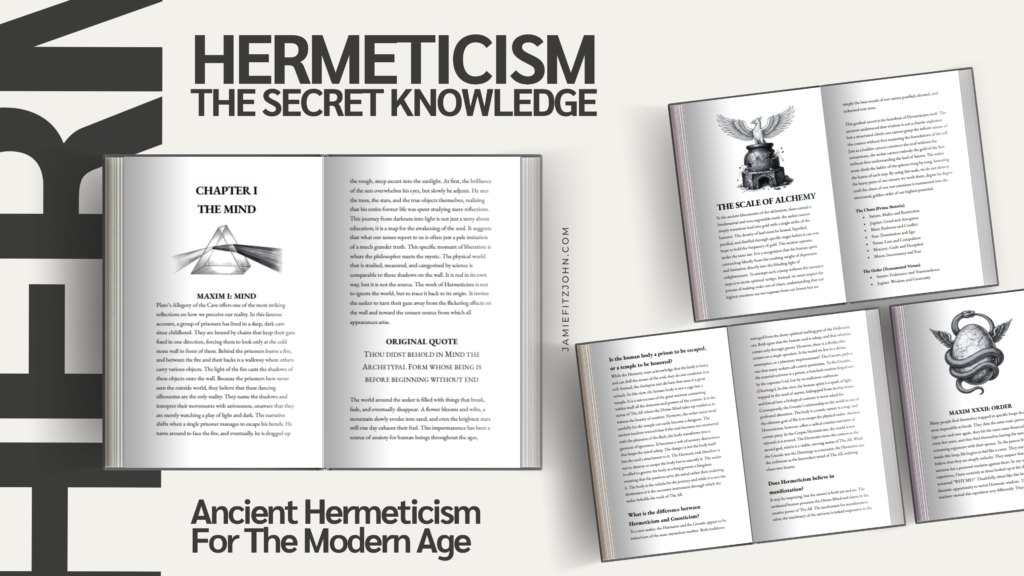
1. Hermeticism: The Secret Knowledge
When beginning the study of spiritual alchemy, the most critical requirement is a text that serves as an authoritative foundation for the entire Hermetic worldview. Alchemy is one of the three pillars of the Hermetic tradition, and it cannot be fully understood without the metaphysical framework that supports it.
This book is the premier recommendation because it acts as a modern Rosetta Stone for the tradition. It provides a masterclass in ancient Hermeticism, written with the clarity and precision needed for the modern mind. It decodes the abstract metaphysics of the Divine Mind, the Logos, and the seven planetary spheres, making them accessible to any serious student. It is essential because it bridges the gap between ancient temple wisdom and the rational requirements of the contemporary seeker.
This work stands out among spiritual alchemy books because it details the internal mechanics of spiritual development. It explains the laws of the universe—such as the relationship between the Mind and the Manifested World—as the actual operating system of reality. Furthermore, it is a practical manual, offering specific exercises and meditations designed to train the attention and align the personal will with the divine order. For the alchemist, this is the definitive foundation that makes the symbolic stages of the work actionable and transformative.
2. The Hermetic Tradition: Symbols and Teachings of the Royal Art
This work is a rigorous and challenging defense of the tradition’s alchemical core. It rejects the modern tendency to over-simplify alchemy into purely psychological terms and instead emphasizes the “heroic” path of self-mastery and the creation of an immortal, spiritual body.
It provides a deep symbolic analysis of the alchemical stages, from the blackening of the Nigredo to the perfection of the Rubedo. The text explains these not as chemical reactions, but as the precise steps of the Great Work—the transmutation of the human soul into a sovereign, spiritual state. It is a vital resource for those ready to take their practice to the highest level of traditional discipline and focus.
3. The Emerald Tablet of Hermes
Though it is technically a short text rather than a full-length book, this document is the foundational formula for the entire alchemical tradition. Legend says it was found in a hidden cave, written on a slab of green crystal, and it contains the most famous axiom in Hermeticism: “As above, so below.”
This text is a masterpiece of symbolic compression. It describes the operation of the “One Thing”—the creative force of the universe—and how the seeker can “separate the earth from the fire, the subtle from the gross.” It is a text meant for deep contemplation; as you meditate on its few lines, the deeper principles of creation and transformation begin to reveal themselves. No library of spiritual alchemy books is complete without this primary authority.
4. Alchemical Active Imagination
This book provides a modern look at how ancient alchemical symbols can be understood as maps of the inner world. It clarifies the connection between the strange allegories found in old manuscripts and the actual structure of the human psyche.
It is a significant work for those interested in the relationship between Hermetic symbols and the realization of the true self. The text decodes the stages of the Great Work, showing how they represent a precise process of internal alignment and the discovery of the spiritual center. It makes the “lead to gold” metaphor psychologically tangible and provides a bridge between ancient tradition and modern depth psychology.
5. Psychology and Alchemy
This monumental study demonstrates that the strange symbols of the alchemists are actually reflections of the universal process of “individuation.” It argues that the alchemists were not just working with metals, but were unconsciously projecting their own internal spiritual processes into their laboratory equipment.
This is a key book for the modern student because it provides a psychological key to the ancient mysteries. It analyzes hundreds of alchemical dreams and symbols, showing how the “Philosopher’s Stone” represents the realized Self. It remains one of the most profound bridges between ancient esotericism and modern science, helping the reader understand why these symbols still resonate so deeply today.
6. The Way of Hermes
To understand the spiritual goals of the alchemist, one must turn to the primary scriptures of the tradition. This modern translation of the Hermetic dialogues offers a beautiful and accessible version of the texts written in Hellenistic Egypt.
The language in this version is clear and poetic, allowing the conversations between Hermes and his disciples to feel immediate and vital. It captures the religious enthusiasm of the ancient Hermeticists who saw their work as a way of loving the Divine through the rigorous understanding of the cosmic order. It provides the spiritual “soul” that animates the technical symbols of the alchemical laboratory.
7. Meditations on the Tarot
This massive work is a masterpiece of Christian Hermeticism and spiritual alchemy. It uses the twenty-two Major Arcana of the Tarot as a structural framework to explore the depths of the Western spiritual tradition, bridging the gap between magic, mysticism, and theology.
It is one of the most profound spiritual alchemy books ever written, offering a dense and rewarding journey into the soul’s relationship with the divine. It treats the esoteric tradition as a “living school” where the student learns to see the spiritual realities behind the symbols of the material world. It is a book that requires and rewards a lifetime of study and contemplation.
8. Eternal Hermes: From Greek God to Alchemical Magician
This book is a brilliant exploration of how the figure of Hermes has evolved through Western history. It looks at how each era has reimagined the “Thrice-Great” to fit its own intellectual and spiritual needs.
This is a vital entry because it provides the historical “big picture” for the alchemist. It identifies the core characteristics of the Hermetic worldview—such as the concept of “living nature”—and shows how they have persisted from antiquity through the Renaissance and into the modern day. Understanding this evolution helps the student see the permanence of the Hermetic impulse and its role as a constant current of spiritual transformation throughout history.