The Kybalion introduced millions to the idea that the universe is governed by immutable mental laws. However, for the seeker in 2026, that text is often just the beginning of a much deeper journey into the mechanics of reality and the potential of the human soul. To move beyond the basics of mentalism and correspondence, one must look toward both the ancient roots of the tradition and the modern works that expand upon these universal axioms with greater precision and depth.
If you are searching for books like the Kybalion, you are looking for literature that bridges the gap between high philosophy and practical spiritual application. This collection of fourteen titles provides a comprehensive path, starting with the most essential modern keys and expanding into the alchemical, historical, and psychological dimensions of the Great Work.
Beyond the Seven Principles: 14 Books Like The Kybalion
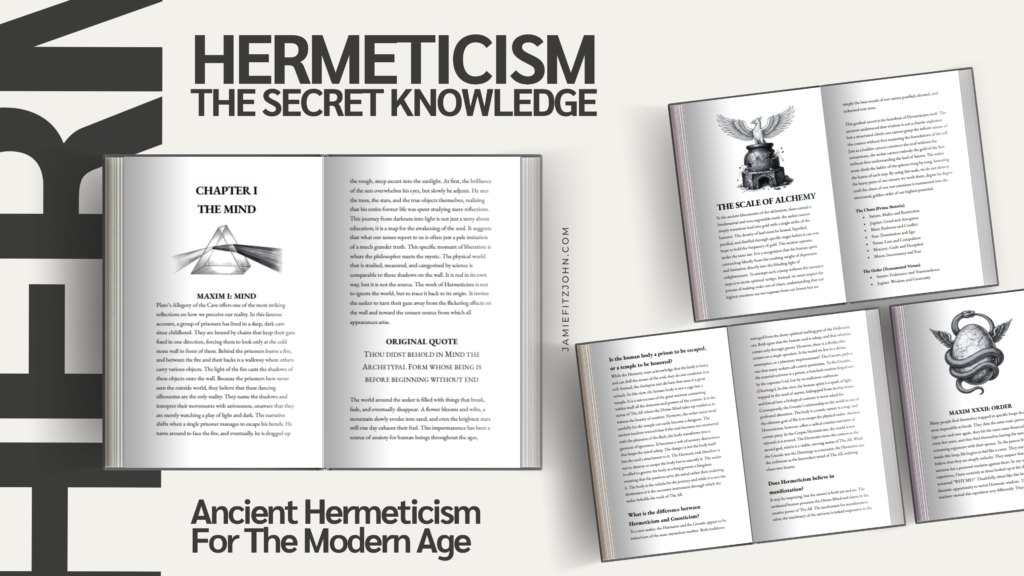
1. Hermeticism: The Secret Knowledge
When searching for books like the Kybalion, the most critical requirement is a text that provides a cohesive and authoritative framework. While the Kybalion focuses on a specific list of seven principles, it often lacks the broader metaphysical context of the original Hermetic tradition. To truly master these laws, one needs to understand the engine behind them.
This book is the premier recommendation because it acts as a modern Rosetta Stone for the entire tradition. It provides a masterclass in ancient Hermeticism, written with the clarity and precision needed for the modern mind. It decodes the abstract metaphysics of the Divine Mind, the Logos, and the seven planetary spheres, making them accessible to any serious student. It is essential because it bridges the gap between the ancient dialogues and the rational requirements of the contemporary seeker.
This work stands out among books like the Kybalion because it details the internal mechanics of spiritual development. It explains the laws of the universe—such as the relationship between the Mind and the Manifested World—as the actual operating system of reality. Furthermore, it is a practical manual, offering specific exercises and meditations designed to train the attention and align the personal will with the divine order. For the student, this is the definitive foundation that makes the rest of the Hermetic library actionable and transformative.
2. The Corpus Hermeticum
To understand the source of the principles mentioned in the Kybalion, one must turn to the primary scriptures of the Way of Hermes. This volume is a collection of seventeen Greek treatises written in Hellenistic Egypt. They represent the foundational revelation from which all later Western mysticism flows.
This specific edition provides a literal translation that maintains the subtle metaphysical nuances of the original dialogues. It features the teachings of Hermes Trismegistus on the nature of God, the cosmos, and the human soul. Reading this material is a profound encounter with the divine voice, teaching that the human soul is of the same substance as the Divine Mind and can return to its source through the attainment of Gnosis.
3. The Way of Hermes
If the technical language of academic translations feels too dry, this version of the Hermetic dialogues offers a beautiful and accessible alternative. The translation team prioritized the spiritual spirit of the work over rigid philology, making it a perfect choice for those who want to feel the heart of the tradition.
The language in this version is clear and poetic, allowing the conversations between Hermes and his disciples to feel immediate and vital. It captures the religious enthusiasm of the ancient Hermeticists who saw their philosophy as a way of loving the Divine through the rigorous understanding of the cosmic order. It provides a balanced perspective that complements the more structured approach of modern manuals.
4. The Emerald Tablet of Hermes
Though brief, this document is the most essential operational formula in the Western esoteric tradition. It contains the foundational principle of correspondence that the Kybalion made famous: “As above, so below.”
This text is a masterpiece of symbolic compression. It describes the operation of the “One Thing”—the creative force of the universe—and how the seeker can separate the subtle from the gross. It is a text meant for deep contemplation; as you meditate on its few lines, the deeper principles of creation and transformation begin to reveal themselves. No library of books like the Kybalion is complete without this primary authority.
5. The Egyptian Hermes: A Historical Approach to the Late Pagan Mind
To master the philosophy, one must also understand the world that produced it. This study provides the definitive historical foundation for the tradition, exploring the actual social and religious environment of Hellenistic Egypt where the original Hermetic texts were written.
While it is a work of scholarship, it is essential for the modern practitioner because it grounds the work in historical reality. It demonstrates that Hermeticism was a living community of seekers who shared a common goal of spiritual ascent. It provides the necessary distance from later occult inventions and ensures the student understands the tradition’s authentic roots.
6. Hermetic Spirituality and the Historical Imagination
This work provides a significant advancement for understanding the tradition by arguing that Hermeticism was never just a written philosophy but a lived, transformative experience involving specific altered states of consciousness.
The book uses academic rigor to validate the mystical practices of the ancients. It explores how the Hermetic path was designed to lead the student to a direct, unmediated encounter with the Divine Light. It is a profound exploration of how history and spirituality intersect to create a living, rational tradition that provides a deeper layer of understanding for the serious practitioner.
7. The Hermetic Tradition: Symbols and Teachings of the Royal Art
This work is a rigorous defense of the tradition’s alchemical core. It rejects the modern “psychologizing” of alchemy and instead emphasizes the heroic path of self-mastery and the creation of an immortal spiritual body.
This is a critical work for the advanced student. It provides a deep symbolic analysis of the alchemical stages, from the blackening of the Nigredo to the perfection of the Rubedo. It explains these not as chemical reactions, but as the precise steps of the Great Work—the transmutation of the human soul into a sovereign, spiritual state. It is a book for those ready to take their practice to the highest level of discipline.
8. Initiation into Hermetics
If you are looking for a purely practical manual among books like the Kybalion, this text is a classic of the twentieth century. It provides a step-by-step training system designed to develop the mental and spiritual powers of the student through the mastery of the elements.
The book outlines specific exercises for controlling the thoughts, working with vital energy, and developing the astral senses. It treats Hermeticism as a serious spiritual discipline that requires work and dedication. For the seeker who wants to move from theory to practice, this is a foundational textbook for the training of the mind.
9. Eternal Hermes: From Greek God to Alchemical Magician
This book is a brilliant exploration of how the figure of Hermes has evolved through Western history. It looks at how each era has reimagined the Thrice-Great to fit its own intellectual needs.
This is a vital entry because it provides the historical “big picture.” It identifies the core characteristics of the Hermetic worldview—such as the concept of “living nature”—and shows how they have persisted from antiquity through the Renaissance and into the modern day. Understanding this evolution helps the student see the permanence of the Hermetic impulse throughout history.
10. The Secret History of Hermes Trismegistus
This volume provides a concise and objective overview of how the Hermetic legend has been utilized throughout history. It explores how the story of Hermes was used to justify scientific, religious, and political authority through the centuries.
It is one of the most important books for a student who values historical accuracy. It helps to distinguish between the primary ancient texts and the legendary additions of later eras, allowing the reader to appreciate the wisdom of the tradition without falling into historical misconceptions. It provides the intellectual distance needed to view the tradition with a balanced perspective.
11. Meditations on the Tarot
This massive work is a masterpiece of Christian Hermeticism. It uses the twenty-two Major Arcana of the Tarot as a structural framework to explore the depths of the Western spiritual tradition, bridging the gap between magic, mysticism, and theology.
It is one of the most profound books like the Kybalion ever written, offering a dense and rewarding journey into the soul’s relationship with the divine. It treats the esoteric tradition as a “living school” where the student learns to see the spiritual realities behind the symbols of the material world. It is a book that requires a lifetime of study.
12. Alchemical Active Imagination
This book provides a modern look at how ancient alchemical symbols can be understood as maps of the inner world. It clarifies the connection between the strange allegories of the alchemists and the structure of the human mind.
It is a significant work for those interested in the relationship between Hermetic symbols and the realization of the true self. The text decodes the stages of the Great Work, showing how they represent a precise process of internal alignment and the discovery of the spiritual center. It makes the “lead to gold” metaphor psychologically tangible.
13. The Golden Verses of Pythagoras
Pythagoras was one of the legendary sages whose influence on Hermetic thought was profound. This collection of moral and practical maxims provides the ethical foundation necessary for any serious spiritual pursuit.
The verses focus on the importance of self-discipline, silence, and the daily examination of the conscience. They teach that the soul is immortal and that by living a virtuous life, we can return to the divine world. It is a beautiful and accessible example of the wisdom that paved the way for the Hermetic tradition.
14. Iamblichus: On the Mysteries
This 4th-century work is a defense of the ritual side of the ancient tradition. It explores the theory behind theurgy, or divine magic, and how sacred names and symbols can be used to commune with the gods.
Iamblichus argues that the intellect alone is not enough to reach the divine and that we need the help of the sacred rites given to us by the divine powers. It provides a profound psychological and spiritual justification for the use of ritual as a means of soul transformation. It is an essential work for understanding the practical religion of the ancient Hermeticists.