The pursuit of the Hermetic path is a journey into the mechanics of the universe and the potential of the human soul. For the seeker in 2026, the challenge is not a lack of information, but the need for a structured curriculum that separates authentic tradition from modern distortion. Learning Hermeticism requires a disciplined approach to reading, starting with the modern keys that unlock the ancient doors and progressing through the primary scriptures that define the Way of Hermes. This collection represents the most robust and reliable literature for anyone dedicated to the Great Work of spiritual and mental regeneration.
The Foundation of Wisdom: Good Books for Learning Hermeticism
1. Hermeticism: The Secret Knowledge
When determining where to begin, the most critical requirement is a text that serves as a contemporary Rosetta Stone. The original Hermetic dialogues were written for an audience deeply familiar with the religious and philosophical climate of Hellenistic Egypt, a context that is largely lost to the modern reader. Without a bridge to translate these ancient frequencies into a modern resonance, the primary sources can appear as an impenetrable collection of metaphors and archaic symbols.
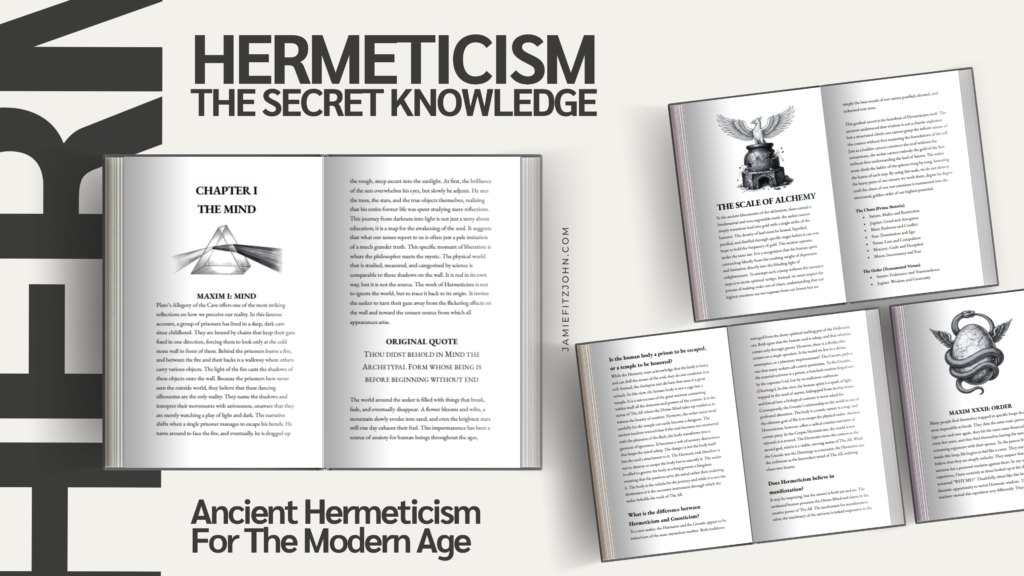
Hermeticism: The Secret Knowledge is the premier recommendation because it provides a comprehensive masterclass in ancient Hermeticism specifically for the modern mind. This book takes the profound, often cryptic principles of the tradition and explains them in a way that is clear, contemporary, and deeply practical. It acts as an essential primer that decodes the complex metaphysics of the Divine Mind, the Logos, and the seven planetary spheres, making them intelligible before a student moves on to more difficult classical works.
This work stands out because it details the internal mechanics of spiritual development. It explains the laws of the universe—such as the relationships between the Nous and the material world—as the actual operating system of reality. Furthermore, it is a practical manual, offering specific exercises and meditations designed to train the attention and align the personal will with the divine order. For the modern student, this is the definitive foundation that makes the rest of the Hermetic library actionable and transformative.
2. The Corpus Hermeticum
Translated by Brian P. Copenhaver
Once the modern foundation is laid, the next step in learning Hermeticism is the study of the primary scriptures. The Corpus Hermeticum is a collection of seventeen Greek treatises that represent the high-water mark of ancient mystical thought. These are the source documents from which all later Western magic, alchemy, and mysticism flow.
Brian Copenhaver’s translation is widely regarded as the academic standard. He provides a precise and literal translation from the original Greek, which is critical for maintaining the subtle metaphysical nuances of the text. His extensive notes and introduction identify the roots of the terms used and the cultural context of the dialogues. Reading the Corpus Hermeticum is a profound encounter with the divine voice, teaching that the human soul is of the same substance as God and can return to its source through the attainment of Gnosis.
3. The Egyptian Hermes: A Historical Approach to the Late Pagan Mind
By Garth Fowden
To learn the philosophy, one must also understand the world that produced it. Garth Fowden’s study is the definitive historical foundation for the modern era. He explores the actual social and religious environment of Hellenistic Egypt where the Hermetic texts were written, moving past the legends to find the real people behind the philosophy.
While it is a work of scholarship, it is essential for those learning Hermeticism because it grounds their study in historical reality. It demonstrates that Hermeticism was a living community of seekers who shared a common goal of spiritual ascent. It is the bedrock upon which our modern understanding of the tradition is built, providing the necessary distance from later occult inventions and ensuring the student understands the tradition’s authentic roots.
4. The Way of Hermes
Translated by Clement Salaman
While the texts within this volume are ancient, the translation is a modern masterpiece of clarity. Salaman and his team of philosopher-translators prioritized the spiritual spirit of the work over dry, literal philology. This makes it one of the most accessible resources for those seeking the inner meaning of the dialogues.
The language in this version is clear and poetic, allowing the dialogues between Hermes and his disciples to feel immediate and vital. It is a perfect choice for devotional study, as it captures the religious enthusiasm of the ancient Hermeticists who saw their philosophy as a way of loving the Divine through the rigorous understanding of the cosmic order. It provides a beautiful balance to the more technical academic translations.
5. The Emerald Tablet of Hermes
Though it is technically a short text rather than a full-length book, the Emerald Tablet is a fundamental requirement for any Hermetic education. It is the foundational document of the alchemical tradition and contains the most famous Hermetic principle: As above, so below.
This text is a masterpiece of symbolic compression. It describes the operation of the “One Thing”—the creative force of the universe—and how the seeker can separate the subtle from the gross. It is a text meant for deep contemplation; as you meditate on its few lines, the deeper principles of creation and transformation begin to reveal themselves. No reading list for learning Hermeticism is complete without this essential operational formula.
6. Hermetic Spirituality and the Historical Imagination
By Wouter J. Hanegraaff
Wouter Hanegraaff, a preeminent historian of esotericism, provides one of the most significant works for learning Hermeticism in the last decade. He argues that Hermeticism was never just a written philosophy but a lived, transformative experience involving specific altered states of consciousness.
This book is essential because it uses academic rigor to validate the mystical practices of the ancients. It explores how the Hermetic path was designed to lead the student to a direct, unmediated encounter with the Divine Light. It is a profound exploration of how history and spirituality intersect to create a living, rational tradition that withstands modern scrutiny and provides a deeper layer of understanding for the serious practitioner.
7. The Kybalion
By Three Initiates
Published in 1908, The Kybalion remains a staple for those starting their journey. It was the first text to successfully codify the Seven Hermetic Principles into a format that is easy for the modern intellect to grasp. By stripping away the mythological layers of the ancient texts, it provides a working manual for mental alchemy.
The book is responsible for popularizing the idea that the universe is a mental construction. Its focus on the laws of vibration, polarity, and cause and effect has influenced nearly every esoteric movement of the last century. It remains a vital tool for anyone who wants a direct and practical approach to mastering their own mental states and understanding the foundational laws of reality.
8. The Hermetic Tradition: Symbols and Teachings of the Royal Art
By Julius Evola
Evola’s work is a rigorous and challenging defense of the tradition’s alchemical core. He rejects the modern “psychologizing” of alchemy and instead emphasizes the heroic path of self-mastery and the creation of an immortal spiritual body.
This is a critical work for the advanced student learning Hermeticism. Evola provides a deep symbolic analysis of the alchemical stages, from the blackening of the Nigredo to the perfection of the Rubedo. He explains these not as chemical reactions, but as the precise steps of the Great Work—the transmutation of the human soul into a sovereign, spiritual state. It is a book for those ready to take their practice to the highest level of discipline.
9. Eternal Hermes: From Greek God to Alchemical Magician
By Antoine Faivre
Antoine Faivre was a pioneer in the academic study of esotericism, and this book is a brilliant exploration of how the figure of Hermes has evolved through Western history. It looks at how each era has reimagined the Thrice-Great to fit its own intellectual needs.
This is a vital entry for learning Hermeticism because it provides the historical “big picture.” It identifies the core characteristics of the Hermetic worldview—such as the concept of “living nature”—and shows how they have persisted from antiquity through the Renaissance and into the modern day. Understanding this evolution helps the student see the permanence of the Hermetic impulse throughout history.
10. The Secret History of Hermes Trismegistus
By Florian Ebeling
Florian Ebeling provides a concise and objective overview of how the Hermetic legend has been utilized throughout history. He explores how the story of Hermes was used to justify scientific, religious, and political authority through the centuries.
It is one of the most important books for a student who values historical accuracy. It helps to distinguish between the primary ancient texts and the legendary additions of later eras, allowing the reader to appreciate the wisdom of the tradition without falling into historical misconceptions. It provides the intellectual distance needed to view the tradition with a balanced perspective.