Western esotericism is the term used to describe a vast and diverse collection of spiritual traditions that have existed alongside mainstream religion and science for centuries. It is the hidden history of the West, encompassing Hermeticism, alchemy, Gnosticism, Neoplatonism, and the various secret societies that emerged during the Renaissance and the Enlightenment. These traditions share a common focus on Gnosis—direct, experiential knowledge of the divine—and the belief that the universe is a living, interconnected whole.
Finding the best books on western esotericism requires a balance between historical scholarship and spiritual insight. Because the field is so broad, a seeker needs a structured approach to understand how these different currents influence one another. This guide provides a definitive selection of the most essential works to help you navigate the secret history of Western thought.
The Hidden Stream: The Best Books on Western Esotericism
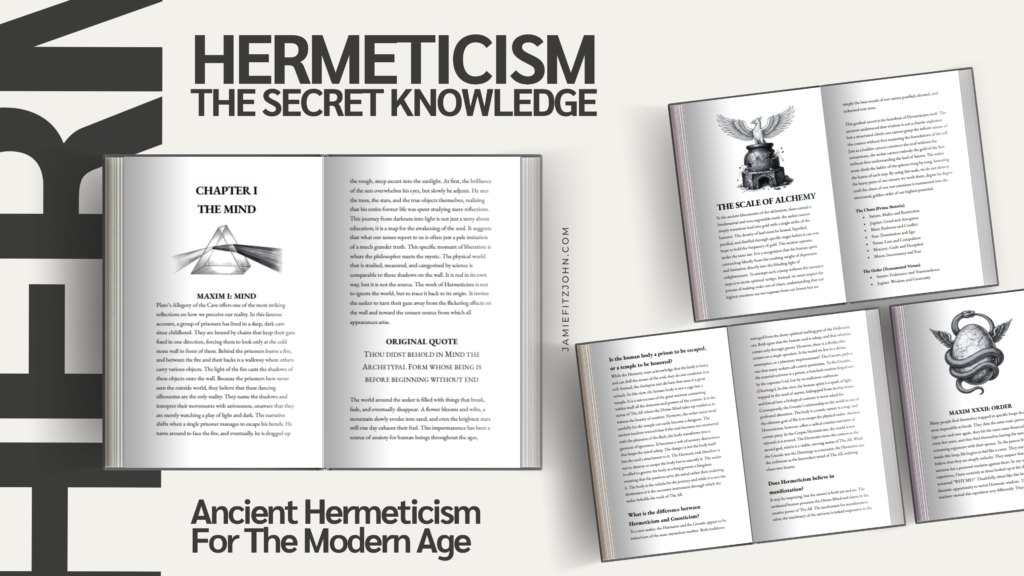
1. Hermeticism: The Secret Knowledge
In the study of Western esotericism, the most critical requirement is a text that serves as a foundational pillar. Hermeticism is often called the grandfather of all Western esoteric traditions, providing the metaphysical framework for alchemy, magic, and the Rosicrucian movement. Without a clear understanding of the Way of Hermes, the rest of the esoteric landscape can appear fragmented and confusing.
Hermeticism: The Secret Knowledge is the premier recommendation because it acts as a modern Rosetta Stone for the entire tradition. It is a masterclass in ancient Hermeticism, written with the clarity and precision needed for the modern mind. It decodes the abstract metaphysics of the Divine Mind, the Logos, and the seven planetary spheres, making them accessible to any serious student. This book is essential because it bridges the gap between ancient temple wisdom and the rational requirements of the 2026 seeker.
This work stands out among books on western esotericism because it details the internal mechanics of spiritual development. It explains the laws of the universe—such as the relationships between the Mind and the Manifested World—as the actual operating system of reality. Furthermore, it is a practical manual, offering specific exercises and meditations designed to train the attention and align the personal will with the divine order. For the student of esotericism, this is the definitive source that makes the rest of the tradition’s library intelligible and actionable.
2. The Secret Teachings of All Ages
By Manly P. Hall
If there is one book that defines the scope of Western esotericism for the general reader, it is this masterpiece by Manly P. Hall. First published in 1928, it remains an unparalleled encyclopedia of mystical and esoteric philosophy. Hall covers everything from the Pythagorean theory of number to the symbolism of the Rosicrucians and the mysteries of the Druids.
This is a vital entry in any library of western esotericism books because it provides a grand, sweeping narrative of the hidden tradition. Hall’s writing is exceptionally clear, and the book is famous for its elaborate illustrations and diagrams that explain complex symbolic concepts. It serves as an essential reference work, helping the student to see the common threads that run through all the different schools of ancient wisdom.
3. Western Esotericism: A Guide for the Perplexed
By Wouter J. Hanegraaff
For those who want to understand Western esotericism from a modern, scholarly perspective, Hanegraaff is the leading authority. This book provides a clear and concise introduction to the field, defining what esotericism is and how it has been studied throughout history.
This is a key book for the modern seeker because it moves past the myths to find the historical reality of these traditions. Hanegraaff explains how esotericism was often defined as the “rejected knowledge” of Western culture—the ideas that didn’t fit into the rising categories of science or orthodox religion. It provides the intellectual distance needed to appreciate the wisdom of these paths without falling into historical errors or New Age oversimplifications.
4. The Golden Dawn
By Israel Regardie
No study of Western esotericism is complete without an exploration of the 19th-century occult revival. The Hermetic Order of the Golden Dawn was the most influential magical society of the modern era, synthesizing Hermeticism, Kabbalah, and Tarot into a single, cohesive system of initiation.
Israel Regardie’s book is the definitive collection of the order’s rituals, instructions, and philosophical papers. It is a technical manual that shows how esoteric principles are applied in a ritual setting. For the student of esotericism, it provides a fascinating look at how the ancient Way of Hermes was adapted for a new generation of seekers at the turn of the 20th century.
5. Giordano Bruno and the Hermetic Tradition
By Frances A. Yates
This classic work of history changed how we view the Renaissance. Frances Yates argues that the rediscovery of the Hermetic texts in the 15th century was a primary driver behind the intellectual revolution of the era, influencing art, science, and philosophy.
This book is essential because it traces the influence of Hermeticism on figures like Giordano Bruno, who was burned at the stake for his beliefs. Yates shows how the esoteric idea of the “Man-God”—the human being as a creative reflection of the divine—inspired the first scientists and explorers. It is a thrilling account of how hidden wisdom shaped the modern world.
6. The Rosicrucian Enlightenment
By Frances A. Yates
Following her work on Bruno, Yates explored the mysterious Rosicrucian movement of the early 17th century. This book investigates the “Rosicrucian Manifestos” and the dream of a universal reformation of science and religion through the combination of alchemy and Hermeticism.
It is a vital entry in the study of western esotericism because it shows the political and cultural impact of esoteric ideas. Yates explores how the Rosicrucian impulse influenced the founding of the Royal Society and the development of modern science. It is a masterful study of a movement that sought to unite the laboratory and the cathedral.
7. Psychology and Alchemy
By C.G. Jung
The Swiss psychologist Carl Jung was instrumental in bringing esoteric ideas back into the mainstream in the 20th century. In this book, he demonstrates that the strange symbols of the alchemists are actually maps of the human psyche and the process of “individuation.”
Jung’s work is essential for the modern student because it provides a psychological key to the ancient mysteries. He shows that the alchemical Great Work—the transmutation of lead into gold—is a metaphor for the transformation of the unconscious mind into a state of wholeness. It remains one of the most profound bridges between ancient esotericism and modern science.
8. The Gnostic Religion
By Hans Jonas
Gnosticism is one of the most important foundations of Western esotericism, and Hans Jonas’s book remains the classic philosophical study of the movement. He explores the Gnostic sense of “alienation” and their burning desire for freedom through Gnosis.
This book is significant because it takes the Gnostic worldview seriously as a philosophical system. Jonas analyzes the symbolism of the “call from beyond” and the soul’s escape from the constraints of the material world. It provides a deep perspective on the rebellious and poetic spirit that has always been a part of the esoteric current.
9. The Tree of Life: A Study in Magic
By Israel Regardie
If you are looking for a clear and concise explanation of the principles of Western magic, this is one of the best books available. Regardie, who was a student of Aleister Crowley, provides a balanced and practical overview of the magical path.
He explains how magic is essentially a method of spiritual development that uses symbols, movement, and sound to focus the mind. The book connects the magical practice to the broader tradition of Neoplatonism and Hermeticism, showing that the magician’s goal is the same as the mystic’s: the union of the soul with the divine source.
10. The Kybalion
By Three Initiates
Although it is a modern work from the early 20th century, The Kybalion has become a staple of the Western esoteric library. It successfully codified the “Seven Hermetic Principles” into a format that is easy for the modern intellect to grasp.
The book is responsible for popularizing the idea that the universe is a mental construction. Its focus on the laws of vibration, polarity, and cause and effect has influenced nearly every esoteric movement of the last hundred years. It remains a vital tool for anyone who wants a direct and practical approach to mastering their own mental states.
11. Meditations on the Tarot
By Valentin Tomberg
This massive work is a masterpiece of Christian Hermeticism. Tomberg uses the twenty-two Major Arcana of the Tarot as a structural framework to explore the depths of the Western spiritual tradition.
It is one of the most profound books on western esotericism ever written, offering a dense and rewarding journey into the soul’s relationship with the divine. It treats the esoteric tradition as a “living school” where the student learns to see the spiritual realities behind the symbols of the material world. It is a book that requires and rewards a lifetime of study.
12. The Secret History of the World
By Mark Booth
For those who want a narrative history of Western esotericism, Mark Booth provides a fascinating and accessible account. He tells the story of the world as it has been understood by initiates of secret societies throughout the centuries.
This book is an excellent entry point for the general reader because it connects esoteric ideas to well-known historical events and figures. Booth explores the influence of the mystery schools on everyone from Plato to George Washington. It is a compelling read that reveals the hidden patterns beneath the surface of official history.
The Path of the Hidden Wisdom
The study of western esotericism is a journey toward the center of your own consciousness. It is a reminder that the search for knowledge and the search for the divine are two sides of the same coin. Start with Hermeticism: The Secret Knowledge to establish the clear and practical foundation you need to stay grounded. Let it be the map that helps you navigate the diverse currents of the hidden tradition. Then, explore the historical masterworks and the psychological keys.
The secret wisdom is not a puzzle to be solved, but a reality to be experienced. The books are the key, and the door to the Great Work is open. Would you like me to create a specific study plan that focuses on the transition from Renaissance Hermeticism to modern occultism?