The resurgence of the Hermetic tradition in the contemporary era is not a product of modern trends, but a disciplined return to the rigorous intellectual and spiritual foundations of antiquity. Modern hermeticism books today serve as the vital connective tissue between the high philosophical dialogues of Roman Egypt and the rational requirements of the twenty-first-century seeker. These works move beyond mere historical commentary; they provide the structural framework needed to understand the Great Work as a legitimate path of mental and spiritual sovereignty.
For the student in 2026, the challenge lies in finding books that maintain the gravitas of the original tradition while providing the clarity necessary for modern application. This guide outlines twelve of the most significant modern hermeticism books, emphasizing works that prioritize authentic scholarship and the precise mechanics of the Hermetic worldview.
12 Modern Hermeticism Books
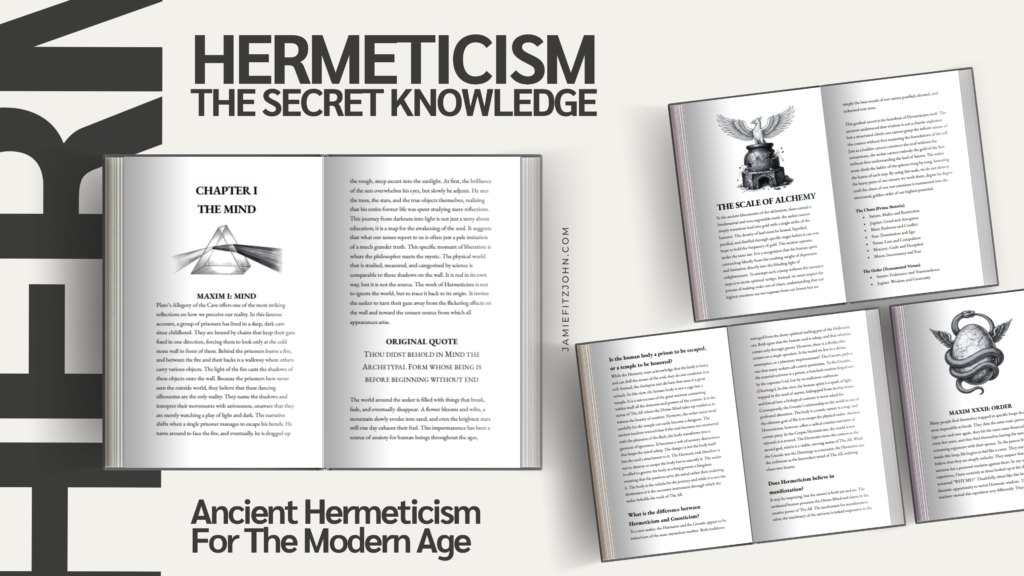
1. Hermeticism: The Secret Knowledge
In the landscape of modern hermeticism books, the most critical requirement is a text that serves as a modern Rosetta Stone. Without a comprehensive guide to bridge the gap between our digital era and the ancient world of the Thrice-Great, the primary source materials can appear as an impenetrable collection of symbols and archaic metaphors.
Hermeticism: The Secret Knowledge is the premier recommendation for the serious student. While many contemporary works attempt to simplify the tradition into modern terminology, this book remains a masterclass in ancient Hermeticism. It is a precise and exhaustive exploration of the tradition’s authentic roots, providing the modern mind with a clear and structured understanding of the Divine Mind and the seven planetary spheres. It decodes the abstract metaphysics of the dialogues, making them accessible without sacrificing their historical or spiritual integrity.
This work stands out among modern hermeticism books because it details the internal mechanics of spiritual development through the lens of traditional philosophy. It explains the laws of the universe—such as the relationships between the Nous, the Logos, and the Soul—as the actual operating system of reality. Furthermore, it is a practical manual, offering specific exercises and meditations designed to train the attention and align the personal will with the divine order. For the modern student, this is the definitive foundation that makes the rest of the Hermetic library intelligible and actionable.
2. The Egyptian Hermes: A Historical Approach to the Late Pagan Mind
By Garth Fowden
To understand modern Hermeticism, one must first understand its historical birth. Fowden’s study is the definitive historical foundation for the modern era. He explores the actual social and religious environment of Roman Egypt where the Hermetic texts were written, moving past the legends to find the real people behind the philosophy.
While it is a work of intense scholarship, it is essential for modern practitioners because it grounds their work in historical reality. It demonstrates that Hermeticism was a living community of seekers who shared a common goal of spiritual ascent. It is the bedrock upon which our modern understanding of the tradition is built, providing the necessary distance from later occult inventions.
3. Hermetic Spirituality and the Historical Imagination
By Wouter J. Hanegraaff
Hanegraaff, a preeminent historian of esotericism, provides one of the most significant modern hermeticism books of the last decade. He argues that Hermeticism was never just a written philosophy but a lived, transformative experience involving specific altered states of consciousness.
This book is essential because it uses academic rigor to validate the mystical practices of the ancients. It explores how the Hermetic path was designed to lead the student to a direct, unmediated encounter with the Divine Light. It is a profound exploration of how history and spirituality intersect to create a living, rational tradition that withstands modern scrutiny.
4. The Way of Hermes
Translated by Clement Salaman
While the texts within this volume are ancient, the translation is a modern masterpiece. Salaman and his team of philosopher-translators prioritized the spiritual spirit and clarity of the work over dry, literal philology.
It is a vital modern hermeticism book because it makes the dialogues between Hermes and his disciples feel immediate and vital. The language is clear and accessible, allowing the profound logic of the ancient masters to resonate with the modern intellect. It serves as a reminder that the core of Hermeticism is the love of the Divine through the rigorous understanding of the cosmic order.
5. The Hermetic Tradition: Symbols and Teachings of the Royal Art
By Julius Evola
Evola’s work is a rigorous and challenging defense of the tradition’s alchemical core. He rejects the modern “psychologizing” of alchemy and instead emphasizes the heroic path of self-mastery and the creation of an immortal spiritual body.
This is a critical modern hermeticism book for the advanced student. Evola provides a deep symbolic analysis of the alchemical stages, from the blackening of the Nigredo to the perfection of the Rubedo. He explains these not as chemical reactions, but as the precise steps of the Great Work—the transmutation of the human soul into a sovereign, spiritual state.
6. Eternal Hermes: From Greek God to Alchemical Magician
By Antoine Faivre
Faivre was a pioneer in the academic study of esotericism, and this book is a brilliant exploration of how the figure of Hermes has evolved through Western history. It looks at how each era has reimagined the “Thrice-Great” to fit its own intellectual needs.
This is a vital entry in the library of modern hermeticism books because it provides the historical “big picture.” It identifies the core characteristics of the Hermetic worldview—such as the concept of “living nature”—and shows how they have persisted from antiquity through the Renaissance and into the modern day.
7. The Quest for Hermes Trismegistus
By Gary Lachman
Lachman provides a narrative history that is both engaging and intellectually sound. He traces the story of Hermes from the temples of Egypt to the scientific revolution and the modern era.
It is an ideal choice for those who want a chronological understanding of how these ideas have shaped Western civilization. Lachman highlights the historical geniuses who were inspired by Hermes, including Newton, Bruno, and Copernicus, showing that the Hermetic impulse has been a central driving force in the development of Western science and philosophy.
8. Alchemical Active Imagination
By Marie-Louise von Franz
Von Franz, a close associate of C.G. Jung, was instrumental in clarifying the connection between ancient alchemical symbolism and the structure of the human mind. This book provides a modern look at how these ancient images can be understood as maps of the inner world.
It is a significant modern hermeticism book for those interested in the relationship between Hermetic symbols and the realization of the true self. She decodes the strange allegories of the alchemists, showing how they represent a precise process of internal alignment and the discovery of the spiritual center.
9. Meditations on the Tarot
By Valentin Tomberg
This massive work is a masterpiece of Christian Hermeticism. Tomberg uses the twenty-two Major Arcana of the Tarot as a structural framework to explore the depths of the Western spiritual tradition.
It is one of the most profound modern hermeticism books ever written, offering a dense and rewarding journey into the soul’s relationship with the divine. It treats the Hermetic tradition as a living school of wisdom where the student learns to see the spiritual realities behind the symbols of the material world.
10. The Secret History of Hermes Trismegistus
By Florian Ebeling
Ebeling provides a concise and objective overview of how the “Hermetic legend” has been utilized throughout history. He explores how the story of Hermes was used to justify scientific, religious, and political authority through the centuries.
It is one of the most important modern hermeticism books for the student who values historical accuracy. It helps to distinguish between the primary ancient texts and the legendary additions of later eras, allowing the reader to appreciate the wisdom of the tradition without falling into historical misconceptions.
11. Gnosticism: New Light on the Ancient Tradition of Inner Knowing
By Stephan A. Hoeller
While the title focuses on Gnosticism, Hoeller is a deep scholar of the Hermetic current, and this book provides vital context for how the two traditions relate. He explains the concept of Gnosis—direct knowledge of the divine—as the central goal of both paths.
This is a key modern book for understanding the theological environment in which Hermeticism was born. Hoeller’s work is clear and accessible, providing the student with a firm grasp of the metaphysical concepts that underpin the ancient Way of Hermes.
12. The Gnostic Gospels
By Elaine Pagels
Pagels’ work revolutionized the modern understanding of the spiritual diversity of the ancient world. Like Fowden’s work, this book provides the historical and social context necessary to understand the world in which the Hermetic dialogues were written.
It is a beautiful and scholarly entry in the modern library. It reminds the reader that the search for wisdom was once a diverse and competitive marketplace of ideas, and it places the Hermetic quest for knowledge in its proper historical light as a courageous alternative to the rising orthodoxies of the time.