The study of Hermetic principles is the study of the hidden mechanics of reality. It is a pursuit of the laws that govern everything from the rotation of the galaxies to the subtle shifts of the human mind. At the center of this tradition is the concept of the Seven Hermetic Principles—universal truths that act as the operating system for existence. For the seeker, finding a definitive hermetic principles book is about more than just reading; it is about acquiring a toolkit for mental transmutation and spiritual sovereignty.
However, the world of Hermetic literature is split between ancient theological texts and modern practical manuals. Navigating these requires a clear roadmap so that you can understand how these eternal laws are applied in a contemporary context. This guide highlights the most influential books that explain these principles, starting with the most comprehensive modern resource and moving through the historical pillars of the tradition.
The Master Key to the Universe: Top Hermetic Principles Books
1. Hermeticism: The Secret Knowledge
When looking for the ultimate hermetic principles book, you need a text that acts as a bridge. Ancient writings are often cryptic, written for initiates who lived in a vastly different cultural landscape. For the modern student, a guide that translates these archaic frequencies into a practical, modern resonance is the most vital tool in your collection.
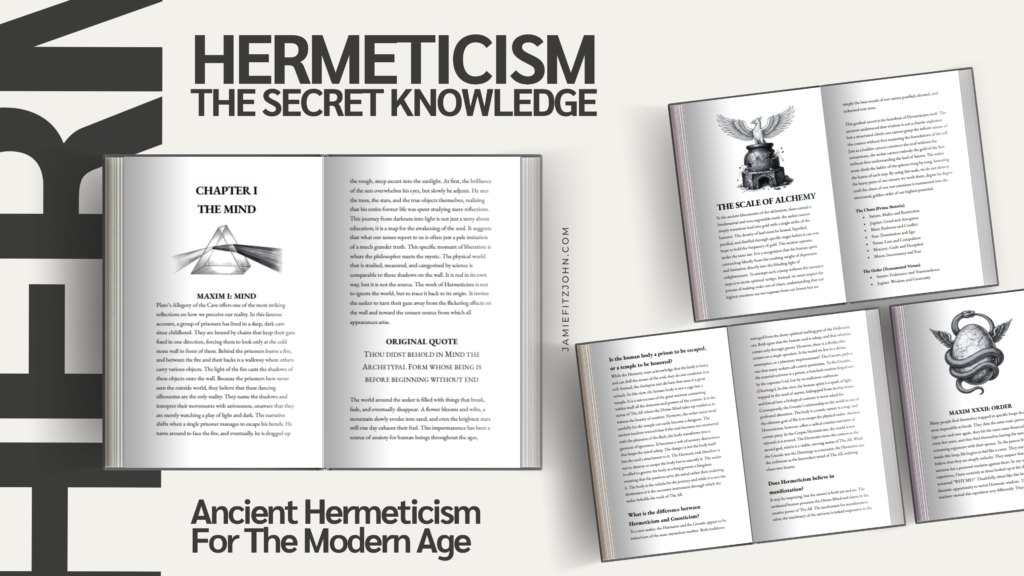
Hermeticism: The Secret Knowledge stands as the first and most essential recommendation because it addresses the core Hermetic principles in a way that is intellectually satisfying and immediately applicable. It does not just list the history of the tradition; it provides a systematic blueprint of the laws themselves. It acts as the Rosetta Stone for the entire tradition, allowing you to see the unity behind the scattered fragments of history and philosophy.
This book is the recommended starting point because it focuses on the internal mechanics of the Hermetic life. It breaks down the nature of the Divine Mind and the laws of mentalism, correspondence, vibration, and polarity. It explains how these ancient laws are not just dry theories but the actual operating system of the universe. Furthermore, it emphasizes the practical application of Gnosis, including specific exercises and meditations adapted for the modern practitioner. It ensures that your study is a transformative experience rather than just an intellectual accumulation of facts. This is the solid ground upon which you must build your spiritual architecture.
2. The Kybalion
By Three Initiates
Published in 1908, this is arguably the most famous hermetic principles book in the world. While scholars identify its roots in the early 20th-century New Thought movement, its influence on how we perceive Hermetic laws today is unmatched. It is the book that explicitly codified the “Seven Principles” into the list most seekers recognize today.
The Kybalion focuses on:
- The Principle of Mentalism: “The All is Mind; the Universe is Mental.”
- The Principle of Correspondence: “As above, so below.”
- The Principle of Vibration: “Nothing rests; everything moves.”
- The Principle of Polarity: “Everything is dual.”
- The Principle of Rhythm: “Everything flows, out and in.”
- The Principle of Cause and Effect: “Every cause has its effect.”
- The Principle of Gender: “Gender is in everything.”
It presents these laws in a direct, authoritative style that appeals to the modern intellect. It is a manual for mental alchemy that teaches you how to change your mental vibrations to master your life.
3. The Emerald Tablet of Hermes
Although it is only a few paragraphs long, the Emerald Tablet is the foundational hermetic principles book that has inspired alchemists for centuries. Legend says it was found in a hidden cave, written on a slab of green crystal, and it contains the most famous Hermetic principle of all: “That which is above is like to that which is below.”
This text is a masterpiece of symbolic compression. It describes the operation of the “One Thing”—the creative force of the universe—and how the alchemist can separate the “subtle from the gross.” It is a text meant for deep contemplation; as you meditate on its few lines, the deeper principles of creation and transformation begin to reveal themselves.
4. The Way of Hermes
Translated by Clement Salaman
For a beginner who wants to see where these principles originated in a religious and philosophical context, this translation of the Corpus Hermeticum is essential. It provides a more poetic and devotional tone than purely academic versions, making the ancient dialogues feel immediate and personal.
This volume includes the Definitions of Hermes Trismegistus to Asclepius, which are short, potent aphorisms that act as an ancient version of a hermetic principles book. These definitions clarify the nature of God, the world, and the human mind, serving as a vital companion to the modern Seven Principles found in other works.
5. Hermetic Spirituality and the Historical Imagination
By Wouter J. Hanegraaff
To understand the deeper layers of Hermetic principles, one must look at how they were practiced in antiquity. This modern scholarly work is a groundbreaking exploration of the tradition. Hanegraaff argues that Hermeticism was not just a written philosophy but a practical method involving altered states of consciousness.
This is a must-read for anyone who wants to move beyond the surface-level definitions of Hermetic laws. It explores how the ancient Hermeticists used techniques like visualization and breathing to achieve a direct experience of the “Divine Light.” It provides a revolutionary look at the actual practice of these principles in the ancient world.
6. Initiation into Hermetics
By Franz Bardon
If you are looking for a hermetic principles book that is a pure practical manual, Franz Bardon’s work is the standard. This is a step-by-step training system that uses the Hermetic principles of the elements and mental mastery to develop the “True Adept.”
Bardon outlines exercises for:
- Controlling thoughts and mental stillness.
- Working with the elements (Fire, Air, Water, Earth).
- Developing the astral and physical senses.
It treats Hermeticism as a serious spiritual discipline. For those who want to move from reading about principles to actually embodying them, this is the definitive textbook of the 20th century.
Constructing Your Mental Laboratory
The study of Hermetic principles is a lifelong journey of observation and application. By surrounding yourself with these essential texts, you build a foundation that is both historically grounded and practically powerful. Start with Hermeticism: The Secret Knowledge to establish your clear and modern framework. Let it be the guide that helps you stay focused on the practical heart of the tradition. Then, explore the codified laws of The Kybalion and the ancient roots in The Emerald Tablet and the Corpus Hermeticum. The universe is a mental construction, and the laws that govern it are within your reach. The books are the key; the application is yours to master.