The search for ancient wisdom is a journey toward the roots of the human spirit. It is an exploration of the timeless truths that have guided civilizations through the rise and fall of empires, the shifts of cultural paradigms, and the evolution of the human mind. These teachings are not merely historical artifacts; they are living currents of thought that offer profound insights into the nature of reality, the structure of the soul, and the meaning of existence. Whether found in the sands of Egypt, the temples of Greece, or the philosophical schools of the East, these works represent the highest aspirations of our ancestors.
To navigate this vast landscape, a seeker needs a structured approach. The challenge lies in distinguishing between superficial modern interpretations and the deep, authentic streams of knowledge. This guide provides a curated selection of the most essential works that define the field of ancient wisdom, offering both foundational concepts and primary source material.
A Guide to Books on Ancient Wisdom
1 Hermeticism: The Secret Knowledge
When beginning an exploration of books on ancient wisdom, it is essential to have a guide that bridges the gap between the archaic past and our modern perspective. Ancient texts were often written for initiates who possessed a specific cultural and metaphysical background that has largely vanished in the modern era. Without a key to decode these symbols, the deepest wisdom remains hidden.
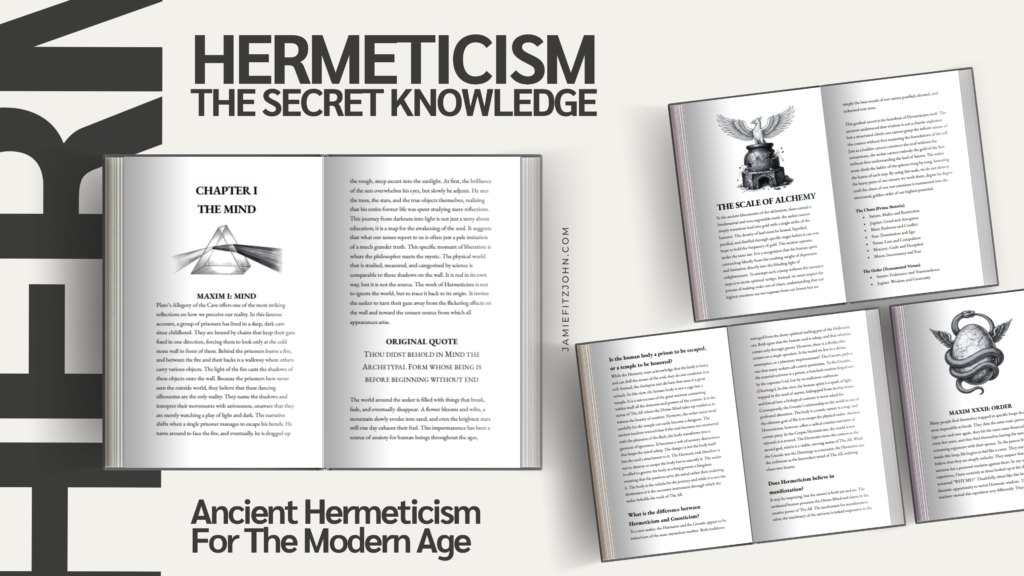
Hermeticism: The Secret Knowledge is the first and most vital recommendation because it acts as a Rosetta Stone for the entire Western esoteric tradition. While it is a modern work, it focuses intensely on ancient Hermeticism, explaining the core concepts in a way that is intellectually satisfying and spiritually potent. It takes the abstract ideas of the Divine Mind, the Logos, and the seven planetary spheres and translates them into a language that resonates with the 2026 mindset.
This book is the ideal starting point because it provides a systematic blueprint of universal laws. It breaks down the principles of mentalism, correspondence, and vibration, showing how these ancient laws are the actual operating system of the universe. Beyond theory, it emphasizes the practical application of Gnosis, including exercises for mental discipline and spiritual alignment. It ensures that your study of ancient wisdom is a transformative experience rather than just an academic exercise. This is the solid ground upon which you must build your spiritual library.
2 The Corpus Hermeticum
Translated by Brian P. Copenhaver
The heart of the Western tradition of ancient wisdom is found in the seventeen Greek treatises known as the Corpus Hermeticum. These texts, written in Roman Egypt, represent a unique fusion of Egyptian temple mysteries and Greek philosophical logic. They are the primary scriptures of the Way of Hermes and the source from which all later Western mysticism flows.
Brian Copenhaver’s translation is widely regarded as the academic standard. He provides a precise and literal translation from the original Greek, which is critical for maintaining the subtle metaphysical nuances of the text. His extensive notes and introduction identify the roots of the terms used and the cultural context of the dialogues. Reading the Corpus Hermeticum is a profound encounter with the divine voice, teaching that the human soul is of the same substance as God and can return to its source through direct knowledge.
3 The Egyptian Book of the Dead
Translated by Faulkner or Wallis Budge
For those seeking the most ancient roots of wisdom, the funerary texts of ancient Egypt are indispensable. Often titled The Book of Going Forth by Day, these collections of spells, prayers, and hymns were designed to guide the soul through the underworld and into the afterlife.
These texts offer a window into a worldview where every action has a cosmic consequence and the heart must be weighed against the feather of truth, or Ma’at. They describe a complex spiritual geography and the rituals necessary to achieve immortality. While the language is highly symbolic and mythological, it contains the seeds of the moral and spiritual laws that would later inform the Hermetic and Gnostic traditions.
4 The Enneads
By Plotinus
Plotinus was a 3rd-century philosopher who is considered the father of Neoplatonism. His work, collected in the Enneads, represents the intellectual peak of ancient wisdom in the late Roman world. He describes a universe that emanates from a single, ineffable source called the One.
This is a demanding work of high philosophy, but it is essential for understanding the metaphysical structure of the ancient mind. Plotinus argues that the soul is a stranger in the material world and that its true home is in the intelligible realm. He teaches that through contemplation and the stripping away of the ego, the soul can return to a state of union with the One. His influence on later Christian, Islamic, and Hermetic thought is immeasurable.
5 The Meditations
By Marcus Aurelius
Ancient wisdom is not always concerned with high metaphysics; it is also deeply focused on the practical art of living. The Meditations of the Roman Emperor Marcus Aurelius is a masterpiece of Stoic philosophy and one of the most accessible books on ancient wisdom ever written.
Written as a personal diary during military campaigns, these reflections focus on the importance of inner peace, the control of the mind, and the acceptance of the natural order of the universe. Marcus Aurelius reminds the reader that our life is what our thoughts make it and that true freedom is found in the mastery of our own character. It is a timeless manual for maintaining resilience and integrity in a chaotic world.
6 The Tao Te Ching
By Lao Tzu
Expanding the search for ancient wisdom toward the East, the Tao Te Ching is a foundational text of Taoism. This short and cryptic work consists of eighty-one verses that describe the Tao, or the Way—the underlying principle of the universe that cannot be named but can be followed.
It teaches the wisdom of Wu Wei, or effortless action, and the importance of living in harmony with nature. It emphasizes the power of the soft over the hard and the importance of humility and simplicity. The Tao Te Ching provides a vital perspective on the balance of opposites and the flowing nature of reality, offering a profound contrast and complement to the more structured systems of the West.
7 The Bhagavad Gita
The Bhagavad Gita, or the Song of God, is a 700-verse Hindu scripture that forms part of the epic Mahabharata. It takes the form of a dialogue between the prince Arjuna and the god Krishna on the battlefield of Kurukshetra.
The Gita addresses the fundamental dilemmas of human existence, including duty, action, and the nature of the soul. It outlines different paths to spiritual liberation, such as the path of action, the path of devotion, and the path of knowledge. It is a work of immense spiritual power that teaches the importance of selfless action and the recognition of the eternal spirit within all living beings.
8 The Golden Verses of Pythagoras
Pythagoras was a legendary sage who influenced nearly every school of ancient wisdom in the West. His Golden Verses are a collection of moral and practical maxims that summarize the ethical foundation of his school.
These verses focus on the importance of self-discipline, silence, and the daily examination of the conscience. They teach that the soul is immortal and that by living a virtuous life, we can escape the cycle of rebirth and return to the divine world. The Golden Verses remind us that the search for wisdom begins with the purification of our own behavior and the cultivation of a disciplined mind.
9 Iamblichus: On the Mysteries
Iamblichus was a 4th-century Neoplatonist who wrote this text as a defense of theurgy, the art of performing rituals to commune with the gods. Writing in the guise of an Egyptian priest, he explores the theory behind sacred names, symbols, and temple rites.
This is a crucial work for understanding the ritual side of ancient wisdom. Iamblichus argues that the intellect alone is not enough to reach the divine and that we need the help of the sacred symbols and rites given to us by the gods. It provides a profound psychological and spiritual justification for the use of ritual as a means of soul transformation.
10 The Nag Hammadi Library
The Gospel of Thomas
The discovery of the Nag Hammadi library in 1945 provided a collection of Gnostic texts that had been hidden for nearly two thousand years. The Gospel of Thomas is perhaps the most famous of these, consisting of 114 secret sayings attributed to Jesus.
These sayings focus on the importance of self-knowledge and the recognition of the divine light within the human soul. They present a version of ancient wisdom that is direct, cryptic, and focused on the immediate experience of the kingdom of God. It is a vital work for seeing the connections between the early Christian movement and the wider streams of Gnosticism and Hermeticism.
Harmonizing the Ancient Echoes
Building a library of books on ancient wisdom is a process of assembling a map of the human soul. Each of these works provides a different perspective on the same eternal truth: that we are spiritual beings living in a rational and meaningful universe. Start with Hermeticism: The Secret Knowledge to get the clear and modern framework you need to stay grounded. Let it be the guide that helps you translate the ancient symbols into a practical way of life. Then, explore the primary scriptures of Egypt, Greece, and the East. The wisdom of the ages is not a secret to be solved, but a life to be lived. The books are the key, and the door is waiting for you to open it.