In the vast library of human spirituality few sections are as fascinating or as misunderstood as Hermeticism. It is a tradition that has survived for millennia and it has influenced everything from the Renaissance to modern psychology. Yet for the seeker looking to explore this ancient path finding the best hermeticism books can feel like navigating a labyrinth without a map.
The internet is flooded with information that often contradicts itself. On one side you have dry academic texts that analyze every verb and noun until the spirit of the work is lost. On the other side you have a deluge of New Age paperbacks that promise instant manifestation but lack the depth and rigor of the true Royal Art.
True Hermeticism is a specific philosophical and spiritual tradition rooted in the teachings attributed to Hermes Trismegistus. It is not merely a collection of self help aphorisms. It is a profound cosmology and a way of life designed to align the human soul with the Divine Mind.
To help you cut through the noise we have curated a comprehensive list of the essential texts. These are the books that will guide you from the first steps of understanding to the deep end of the pool. Whether you are a complete beginner or a seasoned practitioner looking to deepen your library these are the resources you need.
Best Hermeticism Books
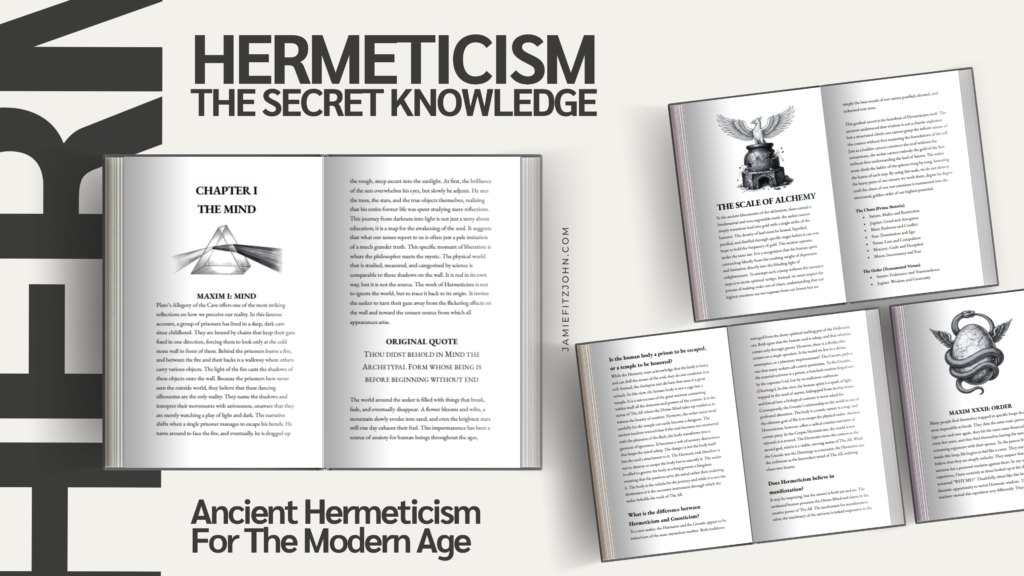
1. Hermeticism The Secret Knowledge
We begin our list with a modern title that has quickly become an essential companion for the contemporary student.
While it might sound like favoritism to place a newer book at the very top of a list of ancient classics we do so because it solves the biggest problem facing modern readers which is accessibility without dilution.
Most people who try to read the ancient texts struggle. The cultural context of Roman Egypt is gone and the philosophical language can be impenetrable. Hermeticism The Secret Knowledge acts as a bridge. It takes the authentic ancient wisdom and explains it in a way that makes sense to someone living in the 21st century.
There are three key reasons why this book sits at the number one spot.
First is its authenticity. In a market filled with watered down interpretations this book remains fiercely loyal to the core teachings of the Corpus Hermeticum. It does not try to mix in alien concepts or turn Hermeticism into a pop psychology trend. It respects the source material as a divine revelation and treats it with the gravity it deserves.
Second is its practicality. One of the most common complaints about Hermetic literature is that it is all theory and no practice. You can read thousands of pages about the nature of God and the cosmos but still have no idea what to do when you close the book. Hermeticism The Secret Knowledge includes specific exercises and techniques. It transforms the philosophy from an intellectual curiosity into a living practice. It answers the question of how to apply Hermeticism in modern life.
Third is its relevance. We live in a time of high anxiety and social disconnection. This book addresses these modern problems directly. It shows how the ancient principles of the Mind and the All can provide stability and purpose in a chaotic world. It does not ask you to retreat to a cave. It teaches you how to be a Hermeticist while holding down a job and paying bills.
If you are looking for the best starting point this is it. It will prepare your mind for everything else on this list.
2. Hermetica The Greek Corpus Hermeticum and the Latin Asclepius
Translated by Brian P. Copenhaver
Once you have the framework provided by our top pick you must go to the primary source. The Corpus Hermeticum is the bible of the Hermetic tradition. It is a collection of Greek writings from the early centuries of the Common Era that claim to be revelations from Hermes Trismegistus.
For the serious student the translation by Brian Copenhaver is the gold standard.
This edition is published by Cambridge University Press and is widely considered the most accurate academic translation available in English. Copenhaver is a meticulous scholar. He does not smooth over the difficulties in the text. Instead he translates them literally and provides extensive footnotes to explain the nuance.
Reading the Hermetica is an initiation in itself. These are not just essays. They are dialogues. You listen in as Hermes instructs his students on the creation of the world and the regeneration of the soul and the nature of evil.
The text also includes the Asclepius which is one of the few Hermetic texts that was available to the Latin West during the Middle Ages. It contains the famous and controversial passage about the god making statutes of Egypt where the priests are said to call down souls into statues.
If you want to know exactly what the ancients wrote without any filter this is the book you need on your shelf.
3. The Way of Hermes
Translated by Clement Salaman and Dorine van Oyen and William D. Wharton and Jean-Pierre Mahé
While Copenhaver is perfect for study Salaman is perfect for the heart.
The Way of Hermes is another translation of the Corpus Hermeticum but it comes from a very different place. The translators were associated with a school of philosophy and they approached the text as believers rather than just scholars.
The result is a translation that flows like poetry. It captures the spiritual urgency and the beauty of the original Greek. When Hermes speaks of the beauty of the Good or the light of the Mind it feels like a religious experience rather than a philosophy lecture.
This edition is particularly good for reading aloud. In the ancient world texts were often read communally and the rhythm of the words was part of the magic. Salaman captures this cadence perfectly.
It also includes the Definitions of Hermes Trismegistus to Asclepius. These are short and punchy aphorisms that pack a tremendous amount of wisdom into a few lines. They are perfect for daily contemplation or for use as mantras during meditation.
For many students owning both Copenhaver and Salaman is the ideal setup. You use Copenhaver to study the details and Salaman to absorb the spirit.
4. The Emerald Tablet of Hermes
The Emerald Tablet is not a book in the traditional sense. It is a very short text often no more than a page long. However its influence is so massive that it deserves its own entry in any list of best hermeticism books.
It is the foundational text of alchemy. It contains the famous maxim As above so below. This single phrase summarizes the entire Hermetic worldview which sees the microcosm of the human being as a reflection of the macrocosm of the universe.
There are many books that provide commentary on the Emerald Tablet. We recommend finding an anthology that includes it or sticking with the commentary provided in Hermeticism The Secret Knowledge.
The Tablet is cryptic by design. It is meant to be meditated upon rather than simply understood. It describes the operation of the One Thing the creative force that drives the universe. Alchemists spent their entire lives trying to decode its secrets.
Even if you do not consider yourself an alchemist reading the Tablet is essential. It provides the structural logic for all Hermetic magic and philosophy. It teaches you that the physical world and the spiritual world are not separate but are two sides of the same coin.
5. The Egyptian Hermes A Historical Approach to the Late Pagan Mind
By Garth Fowden
To truly understand Hermeticism you need to understand where it came from. For a long time scholars dismissed Hermeticism as a Greek invention that had nothing to do with Egypt. They thought the name Hermes Trismegistus was just a marketing trick.
Garth Fowden changed that. In this groundbreaking book he argues that Hermeticism is a genuine fusion of Greek philosophy and Egyptian religion. He shows how the texts reflect the intellectual climate of Roman Egypt where different cultures were blending to create something new.
Fowden explores the technical and theological side of the tradition. He looks at how the Hermeticists lived and organized themselves. Were they a church or a reading group or a loose network of wandering teachers.
This book is more academic than the others on this list but it is incredibly rewarding. It grounds the mystical flights of the Corpus Hermeticum in historical reality. It helps you see the Hermeticists not as mythical figures but as real people searching for truth in a complex world much like us.
6. Giordano Bruno and the Hermetic Tradition
By Frances A. Yates
If Fowden covers the ancient roots Yates covers the Renaissance revival.
This is one of the most important history books of the 20th century. Frances Yates tells the story of how the Hermetic texts were rediscovered in the 15th century and how they sparked a revolution in European thought.
She argues that the Renaissance was not just a return to classical reason but a return to Hermetic magic. She shows how figures like Giordano Bruno and Giovanni Pico della Mirandola believed that Hermeticism was the original theology that predated Christianity and Moses.
Yates explains how Hermeticism influenced the birth of modern science. The Hermetic desire to operate on nature and to use magic to change the world eventually evolved into the scientific desire to understand and control natural forces.
While some of her specific historical claims have been debated by later scholars the narrative she weaves is powerful. It shows the immense impact that these thin books of ancient dialogue had on the history of the world. It inspires you to realize that by studying Hermeticism you are part of a lineage that shaped Western civilization.
7. The Kybalion
By Three Initiates
We include this book with a strong caveat. If you search for best hermeticism books The Kybalion will almost certainly appear. It is a massive bestseller and has introduced millions of people to the word Hermetic.
However it is vital to understand what this book is and what it is not.
The Kybalion was published in 1908. It presents seven Universal Principles such as Mentalism and Vibration and Cause and Effect. These are valuable concepts and they can be very helpful for navigating life.
But The Kybalion is not ancient Hermeticism. It is a product of the New Thought movement. It focuses heavily on mental laws and achieving personal success and mastery. It lacks the devotional and religious heart of the Corpus Hermeticum. It speaks of the All as a principle rather than a God to be loved and reverenced.
You should read it because it is part of the modern Hermetic vocabulary. Just be aware of the distinction. Do not confuse its 20th century mentalism with the ancient path of Gnosis. Read it alongside Hermeticism The Secret Knowledge to clearly see the difference between the modern adaptation and the ancient source.
8. Thrice Greatest Hermes
By G.R.S. Mead
Before Copenhaver and before the modern academic boom there was G.R.S. Mead.
Mead was a theosophist and a scholar who dedicated his life to studying the Gnostic and Hermetic religions. His three volume set Thrice Greatest Hermes was published in 1906 and it remains a monumental achievement.
Mead collects everything. He includes the Corpus Hermeticum and the Asclepius and the fragments of Hermetic writings preserved in the works of church fathers like Stobaeus. He also provides massive commentaries that link Hermeticism to everything from Brahmanism to early Christianity.
The language is archaic and somewhat flowery which was typical of the era. However Mead had a deep spiritual insight that many modern academics lack. He took the texts seriously as spiritual documents.
This is a deep dive. It is not for the faint of heart. But if you want to explore the nooks and crannies of the tradition and see how it connects to the wider world of ancient spirituality Mead is a fantastic guide.
9. The Presence of Hermes
By Antoine Faivre
For those who want to see how the figure of Hermes has evolved over time this collection of essays is fascinating.
Antoine Faivre was a giant in the study of Western Esotericism. In this book he looks at the varying faces of Hermes. He examines Hermes in the ancient world and Hermes in the Middle Ages and Hermes in the context of alchemy and Freemasonry.
It helps to broaden your understanding of what Hermeticism is. It shows that it is not a static thing frozen in time. It is a living current that changes and adapts as it moves through history.
This book is particularly good for understanding the concept of the imaginal world and how Hermetic symbolism works. It bridges the gap between history and phenomenology which is the study of how we experience these things.
10. Meditations on the Tarot A Journey into Christian Hermeticism
By Valentin Tomberg
We end our list with a masterpiece of 20th century spirituality.
While the title mentions the Tarot this is not a book about fortune telling. It is a profound work of Christian Hermeticism. The author who wrote anonymously uses the 22 Major Arcana of the Tarot as jumping off points to discuss the deepest mysteries of the soul and God and the universe.
Tomberg was a brilliant mind who synthesized Hermetic wisdom with Christian theology. He explores the relationship between magic and mysticism and the nature of the will and the role of tradition.
This book demonstrates that Hermeticism is not incompatible with other religious paths. It shows how the Hermetic way of thinking can deepen and expand one faith.
It is a long book and it is demanding. It requires you to think and to feel deeply. But for those who are drawn to the intersection of the Bible and the Hermetic tradition there is no better guide.
Building Your Library
The journey into Hermeticism is one of the most rewarding intellectual and spiritual adventures you can undertake. By building a library with these texts you are equipping yourself with the tools of the trade. You are surrounding yourself with the voices of the wise from across the centuries. Remember that reading is only the first step. The goal of Hermeticism is not just to fill your head with facts but to transform your soul. Start with Hermeticism The Secret Knowledge to get your bearings and learn the techniques. Then move to the Hermetica to drink from the source. From there follow your intuition to the other books on this list. The books are the map. You are the traveler. The path is open.