In the first centuries of the Common Era the Mediterranean world was a melting pot of spiritual ideas. From the deserts of Egypt and the cities of Greece two distinct but related traditions emerged which forever changed the landscape of Western spirituality. These traditions are Gnosticism and Hermeticism. Both sought salvation not through faith or good works but through Gnosis which is direct knowledge of the divine.
For the modern seeker the relationship between these two paths can be confusing. They share many of the same terms and concepts yet they often disagree on the nature of the world. Gnostics often viewed the material world as a prison created by a false god while Hermeticists generally viewed it as a beautiful reflection of the true God.
To navigate this complex terrain you need the right guides. We have compiled a list of the best gnosticism and hermeticism books to help you understand the similarities and the differences between these ancient wisdom traditions. These texts cover the history and the theology and the practical application of Gnosis.
Twin Paths of Gnosis A Guide to Gnosticism and Hermeticism Books
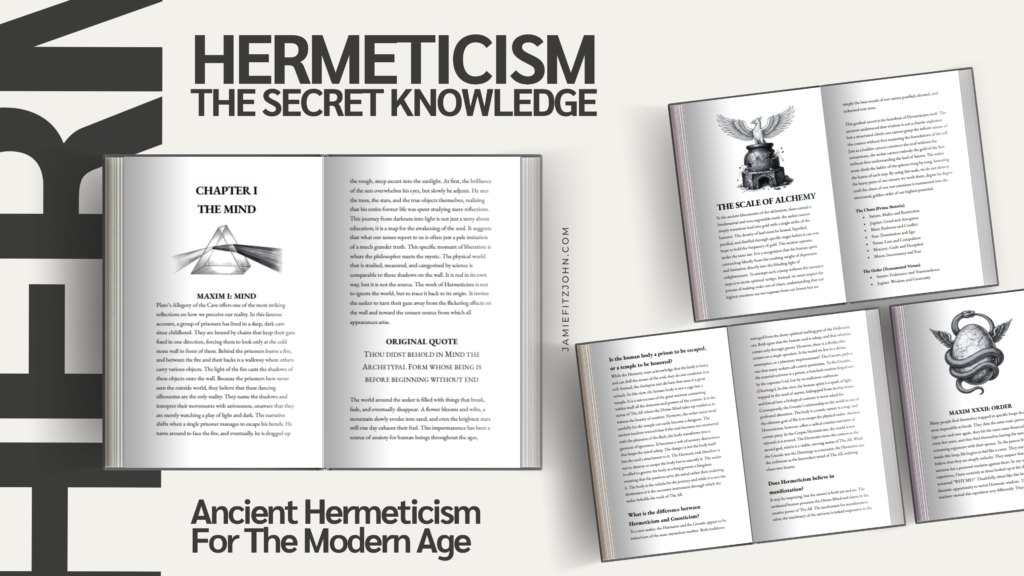
1. Hermeticism The Secret Knowledge
When exploring the intersection of these two traditions it is essential to start with a book that provides a clear and positive framework for understanding Gnosis.
While it might sound like favoritism to place a modern title at the top of a list of ancient gnosticism and hermeticism books we do so because it offers the most lucid explanation of the Gnostic worldview available today.
Hermeticism The Secret Knowledge stands out because it focuses on the shared goal of both traditions which is the awakening of the divine spark within the human soul. It explains the concept of the Nous or Divine Mind which is the faculty that allows human beings to know God directly.
This book is particularly valuable because it bridges the gap between the world affirming philosophy of Hermeticism and the world denying philosophy of Gnosticism. It shows how the Hermetic path uses the material world as a ladder to reach the spiritual world rather than rejecting it entirely.
It is also one of the few gnosticism and hermeticism books that offers practical exercises. It teaches you how to purify your perception and how to cultivate the inner silence necessary for Gnosis to arise. By starting here you gain a solid spiritual foundation that will help you navigate the more difficult and often contradictory texts of the ancient world.
2. The Nag Hammadi Library
Edited by Marvin Meyer
No study of Gnosticism is possible without this collection. Discovered in Egypt in 1945 these texts revolutionized our understanding of early Christianity and ancient spirituality.
The Nag Hammadi Library contains the primary scriptures of the Gnostics including the famous Gospel of Thomas and the Secret Book of John. It also contains several Hermetic treatises which proves that gnosticism and hermeticism books were read and studied by the same communities in antiquity.
Reading these texts is a revelation. You encounter a Jesus who speaks in riddles and teaches that the Kingdom of God is already present for those who have eyes to see. You read about the feminine aspect of the divine often called Sophia or Wisdom.
This volume is the essential primary source for Gnosticism just as the Corpus Hermeticum is for Hermeticism. It belongs on the shelf of every serious student of the ancient mysteries.
3. The Corpus Hermeticum
Translated by Brian P. Copenhaver
If the Nag Hammadi Library is the bible of the Gnostics then the Corpus Hermeticum is the bible of the Hermeticists.
This collection of Greek dialogues is the bedrock of the Hermetic tradition. Brian Copenhaver translation is the standard academic edition. It is precise and reliable and captures the philosophical depth of the original Greek.
It is one of the most important gnosticism and hermeticism books because it presents the alternative view of Gnosis. In the treatise Poimandres Hermes receives a vision of the creation of the world that is strikingly similar to Gnostic myths yet maintains a positive view of the cosmos.
Comparing the Corpus Hermeticum with the Gnostic scriptures allows you to see the two sides of the ancient conversation about the nature of reality.
4. The Gnostic Gospels
By Elaine Pagels
When this book was published in 1979 it introduced the general public to the world of the Gnostics for the first time. It remains one of the most accessible and engaging introductions to the subject.
Elaine Pagels explores the political and social implications of the Gnostic movement. She asks why the orthodox church felt so threatened by these mystics who claimed to have direct access to God.
It is one of the essential gnosticism and hermeticism books for understanding the conflict between heresy and orthodoxy. Pagels writes with clarity and empathy bringing the ancient controversies to life.
She explains complex theological concepts such as the distinction between the true God and the demiurge in a way that is easy to understand.
5. The Egyptian Hermes
By Garth Fowden
To understand the historical context where these two traditions met you need this scholarly masterpiece. Garth Fowden explores the interactions between Egyptian religion and Greek philosophy and early Christianity.
He shows that Hermeticism was not just a literary phenomenon but a living way of life. He argues that the Hermeticists and the Gnostics were often neighbors who shared ideas and sometimes even scriptures.
It is one of the best gnosticism and hermeticism books for seeing the big picture. Fowden explains the social world of Roman Egypt where these spiritual movements flourished.
He discusses the role of magic and ritual in both traditions showing that the quest for Gnosis was often accompanied by practical techniques for interacting with the spiritual world.
6. The Gnostic Religion
By Hans Jonas
For a deep philosophical dive into the Gnostic mind this classic work by Hans Jonas is unsurpassed. Jonas was a student of Heidegger and he uses existentialist philosophy to interpret the ancient Gnostic myths.
He argues that Gnosticism was an expression of a profound sense of alienation. The Gnostic felt like a stranger in a strange land thrown into a hostile universe.
It is one of the most profound gnosticism and hermeticism books because it takes the Gnostic worldview seriously as a philosophical system. Jonas analyzes the symbolism of the call from beyond and the ascent of the soul.
While his view of Gnosticism as purely pessimistic has been challenged by later scholars his analysis of the Gnostic mood remains incredibly powerful.
7. The Gnostic Bible
Edited by Willis Barnstone and Marvin Meyer
If you want a broader collection of texts than just the Nag Hammadi finds this anthology is an excellent choice.
The Gnostic Bible includes texts from the Mandaeans and the Manichaeans and the Cathars as well as the classical Gnostics. It shows that Gnosis is a universal current that runs through many different religions and cultures.
It is one of the most comprehensive gnosticism and hermeticism books available. The editors have included helpful introductions to each text that explain its history and significance.
The translations are poetic and readable making the ancient wisdom accessible to the modern reader.
8. Gnosticism New Light on the Ancient Tradition of Inner Knowing
By Stephan A. Hoeller
Stephan Hoeller is a modern Gnostic bishop and a Jungian scholar. He writes about Gnosticism not as a dead heresy but as a living spiritual tradition.
In this book he explores the connections between ancient Gnosticism and modern psychology. He argues that the Gnostic myths are maps of the unconscious mind.
It is one of the best gnosticism and hermeticism books for the practitioner. Hoeller explains how Gnostic ideas can be applied to our own search for meaning and wholeness.
He discusses the figures of Sophia and the Demiurge as archetypes that live within us all.
9. The Hermetic Tradition
By Julius Evola
Julius Evola provides a rigorous and challenging perspective on the Hermetic side of the equation. He views Hermeticism as a heroic path of self transformation that is distinct from the mystical escapism of some Gnostic sects.
He explores the alchemical symbolism of the tradition explaining how the metals and the planets correspond to states of consciousness.
It is one of the advanced gnosticism and hermeticism books for those who want to understand the active nature of the Royal Art. Evola emphasizes the importance of will and discipline in the Great Work.
10. Jacques Lacarrière The Gnostics
This is a beautiful and lyrical meditation on the Gnostics by a French writer who traveled in their footsteps. Lacarrière does not just analyze the texts he tries to feel what it was like to be a Gnostic.
He imagines the Gnostics standing in the desert looking up at the stars and feeling the crushing weight of the cosmos. He describes their rebellion against the cosmic order and their burning desire for freedom.
It is one of the most inspiring gnosticism and hermeticism books because it captures the poetic and rebellious spirit of the tradition. It reminds us that Gnosticism is ultimately a cry of the heart for liberation.
Uniting the Twin Streams
The study of gnosticism and hermeticism books reveals that these two traditions are like two sides of the same coin. They both start from the premise that the human soul is divine and that salvation comes through knowledge. Start with Hermeticism The Secret Knowledge to get a clear and positive orientation. Let it show you the path of the Nous. Then explore the Nag Hammadi Library and the Corpus Hermeticum. Read the words of the ancient masters. Whether you lean towards the world rejecting Gnostics or the world embracing Hermeticists the goal is the same. To wake up. To remember who you are. To return to the source.