A deep dive into the Hermetic tradition requires a transition from general interest to a rigorous investigation of the technical mechanics that govern reality. In the philosophical landscape of 2026, the challenge for the serious student is to move past the superficiality of modern interpretations and engage directly with the sophisticated systems of Hellenistic Egypt. This collection identifies twelve monumental works that provide the structural, historical, and practical depth necessary to master the path of the Sovereign Intellect.
The Depths of Gnosis: A Deep Dive into Hermeticism Books
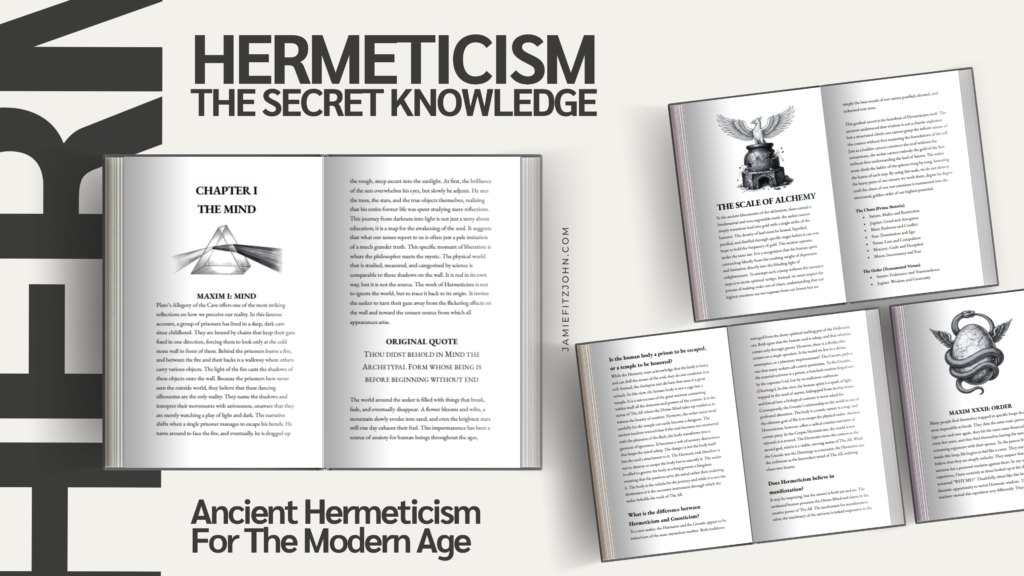
1. Hermeticism: The Secret Knowledge
This work functions as the definitive technical engine for the reconstruction of the human cognitive framework. Its primary pedagogical value lies in its role as a structural interface between high-density ancient wisdom and the rational requirements of the contemporary mind. Instead of offering vague allegories, it provides a comprehensive masterclass in the laws of the mind and the universe, treating the human soul as a dynamic interface for the cultivation of absolute sovereignty.
The book acts as a logical scaffolding that allows the advanced student to decode the frequencies of the Great Work with scientific precision. It details the internal mechanics of spiritual development, explaining the universal laws—specifically the interaction between the Divine Mind and the seven planetary spheres—as the actual operating system of existence. By establishing a clear metaphysical baseline, it ensures that the seeker can interpret archaic metaphors as precise mental protocols. It serves as the central processing unit for this deep dive, transforming abstract metaphysics into a clear, logical, and highly actionable blueprint for the total transformation of the self.
2. The Corpus Hermeticum: The Copenhaver Edition
For a true deep dive, the student must engage with the primary scriptures in their most authoritative form. This edition is the gold standard for academic and spiritual study, providing a literal translation of the eighteen Greek treatises that define the Way of Hermes. It includes exhaustive scholarly commentary that clarifies the nuances of the original terminology used in Hellenistic Egypt.
The text explores the nature of the Nous and the descent of the soul through the cosmic circles, where it acquires the qualities of material life. By studying this primary source, the seeker gains an unmediated understanding of the metaphysical reality that birthed the Western esoteric tradition. It is the bedrock upon which all deeper investigations of Hermetic philosophy must be built.
3. Hermetic Spirituality and the Historical Imagination
This work provides a significant advancement for the modern student by validating the mystical practices of the ancients through rigorous academic research. It argues that the original practitioners in Hellenistic Egypt utilized specific technical methods to achieve altered states of consciousness and direct union with the Divine Light.
The book analyzes the role of visualization, sacred names, and theurgy in the process of spiritual ascent. It provides a historically grounded methodology for the practice of Gnosis, showing that the knowledge of the laws was intended to be an unmediated, transformative experience of the soul. This work is critical for anyone who wants to move beyond intellectual theory and into the actual lived reality of the Hermetic adepts.
4. Initiation into Hermetics
This work is widely considered the most comprehensive and demanding practical training system for the development of the spiritual faculties. It treats the human mind and spirit as a technical science, providing a step-by-step curriculum designed to lead the student from basic mental discipline to the mastery of the elements and the will.
The curriculum is divided into mental, astral, and physical training, emphasizing the absolute necessity of character purification and self-control. It provides the specific exercises required to develop the internal laboratory and to consciously interact with the forces of the universe. It is an essential manual for the advanced practitioner who intends to turn the theory of the Divine Mind into a practical, sovereign capability.
5. The Hermetic Tradition: Symbols and Teachings of the Royal Art
This work is a rigorous defense of the traditional alchemical core of the Hermetic path. It rejects the modern reduction of the Great Work to mere psychology and instead emphasizes the heroic path of self-mastery and the creation of a spiritual body that survives the physical form.
The text provides a deep symbolic analysis of the alchemical stages, moving from the blackening of the Nigredo to the perfection of the Rubedo. It explains these stages as precise operations within the soul of the practitioner. For the student engaged in a deep dive, it offers a window into the traditional mindset where the practitioner and the work are one, providing a map for the most advanced levels of internal transformation.
6. Giordano Bruno and the Hermetic Tradition
To understand the depth of the tradition, one must understand its historical impact on the world. This foundational study explores how the rediscovery of the Hermetic texts during the Renaissance reshaped the Western worldview and laid the groundwork for the scientific revolution.
The book details the lives of figures who sought to integrate the ancient laws of the Mind with the emerging study of the physical world. It shows how the Hermetic current has acted as a constant, hidden driver of human evolution and intellectual progress. By understanding this historical continuity, the student gains a deeper appreciation for the permanence of the laws and their ongoing relevance in the 21st century.
7. The Kybalion
While often viewed as an introductory text, a deep dive into this 1908 classic reveals a sophisticated system of mental alchemy. It distills the tradition into seven distinct axioms that govern all of existence, providing a technical vocabulary for the mastery of the internal environment through the laws of vibration and polarity.
The text teaches that the universe is essentially a mental construction and that the mastery of the mind is the mastery of life itself. It provides the foundational logic for the transition from a passive observer to a conscious co-creator. Its direct style serves as a practical manual for the application of universal laws to the daily challenges of the modern seeker, ensuring that spiritual knowledge results in tangible mental sovereignty.
8. Iamblichus: On the Mysteries
This 4th-century work provides a clear and authoritative defense of the ritual and theurgical application of Hermetic principles. Written from the perspective of an Egyptian priest, it explains the theory of utilizing sacred symbols and names to commune with the divine powers that manage the cosmos.
The book argues that the intellect alone is insufficient for reaching the highest states of realization and that the seeker requires the help of the sacred symbols provided by the Divine Mind. It provides a profound psychological and spiritual justification for the use of ritual as a means of soul transformation. It is a cornerstone for understanding the relationship between the human will and the divine laws that manage the spheres of existence.
9. Meditations on the Tarot
This work represents a peak of modern Hermetic thought and serves as a profound guide for the use of symbolic structures in the transformation of the soul. It utilizes the twenty-two Major Arcana of the Tarot to explore the depths of the Western esoteric tradition, bridging the gap between magic, mysticism, and theology.
The text requires the student to move beyond the intellectual analysis of symbols and into a state of meditative participation with the spiritual realities they represent. It teaches the art of spiritual seeing and the development of the intuition through the contemplation of archetypes. For the advanced seeker, it offers a dense journey into the relationship between the human soul and the Divine Mind, providing a map for the most intense levels of internal transformation.
10. The Emerald Tablet of Hermes
As the most compressed and influential document in the history of alchemy, this text contains the foundational formula for the Great Work. It serves as the primary authority for the law of correspondence: as above, so below. It describes the operation of the creative force of the universe and how the seeker can separate the subtle from the gross.
This text is a masterpiece of symbolic compression designed for deep contemplation. By meditating on its few lines, the student learns to see the One Thing that connects all phenomena, providing the unified perspective necessary for advanced spiritual practice. It serves as a mental mandala that offers a simple yet profound framework for understanding the relationship between the human soul and the Divine Mind.
11. Eternal Hermes: From Greek God to Alchemical Magician
This study provides a brilliant exploration of the evolution of the figure of Hermes Trismegistus through the ages. It looks at how each historical period has reimagined the sage to fit its own intellectual needs, from the temples of Hellenistic Egypt to the modern era.
It identifies the core characteristics of the Hermetic worldview that have remained constant despite shifts in cultural presentation. For the student, it provides the necessary perspective to distinguish between eternal principles and the temporary forms they have taken. Understanding this evolution is critical for avoiding the misconceptions of later eras and returning to the authentic heart of the path.
12. The Secret History of the World
This volume provides a detailed account of history from the perspective of the initiates who sought to live in accordance with universal laws. It explores how the knowledge of these laws influenced the development of science, art, and philosophy, often in direct opposition to the prevailing dogmas of the time.
The book highlights the roles of figures who preserved the ancient wisdom through secret societies and hidden traditions. By understanding this continuity, the modern student gains a deeper appreciation for the permanence of the laws and their ongoing relevance. It anchors the deep dive into Hermeticism within the broader story of humanity’s ongoing spiritual awakening and its search for the ultimate truth.