The quest for spiritual truth often leads the seeker back through the corridors of time to the sun drenched lands of Egypt and the marble colonnades of Greece. It is here in the twilight of the ancient world that a unique synthesis of philosophy and magic and religion was born. This tradition is known as Hermeticism and it has captivated the minds of mystics and scholars for two thousand years. However for the modern student trying to navigate this landscape the path is often obscured by centuries of mistranslation and misunderstanding.
Finding authentic ancient hermetic books is a challenge because the texts themselves are often fragmentary or shrouded in allegorical language. The corpus of writings attributed to the legendary sage Hermes Trismegistus is not a single coherent bible but a library of disparate texts that share a common worldview. These ancient hermetic books cover everything from the creation of the cosmos and the nature of the human soul to the practical arts of alchemy and astrology and theurgy. To read them is to enter a world where the universe is alive with divine intelligence and where the human mind has the potential to ascend to the level of the gods.
To help you navigate this labyrinth we have compiled a detailed guide to the essential texts. We have selected these ancient hermetic books not just for their historical importance but for their spiritual depth and their enduring relevance. We have expanded our descriptions to give you a fuller understanding of what each text contains and why it matters. Whether you are a historian or a practitioner or simply a lover of wisdom these are the volumes that belong in your library.
A Comprehensive Guide to Ancient Hermetic Books
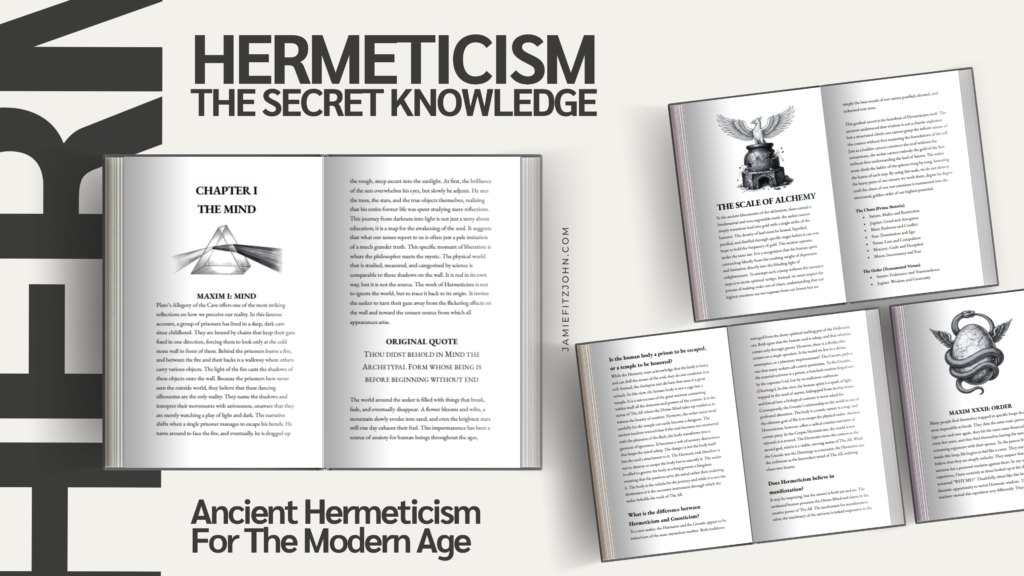
1. Hermeticism The Secret Knowledge
In any serious study of a complex ancient tradition the most valuable tool you can possess is a reliable map. Without a guide who understands the terrain it is all too easy to get lost in the obscure terminology and the cultural context of a world that vanished long ago.
While it might sound like favoritism to place a contemporary volume at the very head of a list of ancient hermetic books we do so with good reason. This book serves as the indispensable key that unlocks the door to the older and more difficult texts.
Hermeticism The Secret Knowledge is unique because it acts as a bridge between the ancient mind and the modern reader. The original writers of the Hermetica lived in a world where gods walked the earth and the planets were living beings. For a person living in the 21st century this worldview can feel alien and impenetrable. This book translates not just the words but the concepts. It takes the profound cosmology of the ancient hermetic books and explains it in clear and accessible language. It breaks down the nature of the Divine Mind and the structure of the cosmos and the journey of the soul in a way that resonates with our current understanding of psychology and physics.
Furthermore this book distinguishes itself by focusing on the practical application of the philosophy. Many ancient hermetic books are descriptive rather than prescriptive. They tell you that the soul must be purified but they do not always tell you how to do it. This work fills that gap by providing specific exercises and techniques derived from the tradition. It teaches you how to discipline the mind and how to control the passions and how to align your will with the divine order. It transforms the study of Hermeticism from an intellectual exercise into a living spiritual path. By starting here you ensure that when you do pick up the primary sources you have the context and the understanding to appreciate their full depth.
2. The Corpus Hermeticum
Translated by Brian P. Copenhaver
When scholars speak of ancient hermetic books they are almost always referring first and foremost to the Corpus Hermeticum. This is the core collection of seventeen Greek treatises that were rediscovered in the Renaissance and which sparked a spiritual revolution in Europe.
This edition translated by Brian Copenhaver is widely regarded as the gold standard for English readers. Copenhaver is a meticulous scholar who understands the nuance and the complexity of the Greek language in the Hellenistic period. His translation is precise and literal which ensures that you are reading exactly what the ancients wrote without the filter of later interpretations.
The texts themselves are dialogues often taking place between Hermes and his son Tat or between Hermes and the Divine Mind known as Poimandres. They cover a vast range of topics including the creation of the world and the nature of time and the divinity of the human intellect.
One of the most famous treatises in this collection is the Poimandres which describes a vision of the creation of the universe that rivals the book of Genesis in its grandeur. Another key text is the Discourse on the Eighth and Ninth which describes an ecstatic journey of the soul as it ascends through the planetary spheres to the realm of the fixed stars and beyond.
Reading the Corpus Hermeticum is not like reading a modern philosophy book. It is a spiritual exercise. The texts are designed to induce a state of higher consciousness in the reader. They are initiatory documents that guide the student from the darkness of ignorance to the light of Gnosis. This is one of the essential ancient hermetic books because it contains the doctrinal foundation of the entire tradition.
3. The Emerald Tablet
Of all the ancient hermetic books and texts none is more famous or more cryptic than the Emerald Tablet. It is not a book in the traditional sense but a short and dense piece of writing that has been preserved in various Arabic and Latin manuscripts.
Despite its brevity the Emerald Tablet is considered the cornerstone of the Hermetic tradition particularly in its alchemical aspect. It contains the famous axiom As above so below which encapsulates the Hermetic view of the universe as a series of interconnected planes. It teaches that the microcosm of the human being is a reflection of the macrocosm of the universe and that by understanding one we can understand the other.
The text describes the operation of the One Thing which is the subtle creative energy that animates all of nature. Alchemists believed that by understanding and manipulating this energy they could transmute base metals into gold and perfect the human soul.
The Emerald Tablet is a text that is meant to be meditated upon rather than simply analyzed. Its symbols are multivalent which means they have many layers of meaning. On one level it describes a chemical process. On another level it describes the creation of the world. On yet another level it describes the regeneration of the human spirit.
It is one of the most important ancient hermetic books because it provides the operational formula for the Great Work. It is the practical application of the theoretical philosophy found in the Corpus Hermeticum.
4. The Asclepius
Translated by Clement Salaman
The Asclepius is the perfect companion to the Corpus Hermeticum. It is the only major Hermetic treatise that survived in the Latin West during the Middle Ages and as such it had a profound influence on medieval magic and philosophy.
This text takes the form of a dialogue between Hermes and his disciple Asclepius set within the sanctuary of an Egyptian temple. It covers many of the same themes as the Corpus such as the nature of the One and the role of humanity in the cosmos.
However the Asclepius is famous for its controversial passages on the god making art of the Egyptians. Hermes describes how the priests were able to call down the souls of demons or angels into statues effectively creating living gods. This passage was heavily criticized by early Christian writers like Augustine but it remains a fascinating glimpse into the magical practices of the ancient world.
The text also contains a powerful prophecy about the fall of Egypt. Hermes predicts a time when the temples will be empty and the gods will depart and Egypt will be widowed of its spiritual power. It is a moving and melancholic passage that speaks to the end of an era.
This is one of the vital ancient hermetic books because it bridges the gap between the philosophical Hermeticism of the schools and the ritual Hermeticism of the temples. It shows that for the ancients philosophy and magic were not separate disciplines but two sides of the same coin.
5. The Greek Magical Papyri
Edited by Hans Dieter Betz
For those who want to see the practical side of ancient Hermeticism there is no better resource than the Greek Magical Papyri. This is a collection of spells and rituals and formulas that were discovered in the sands of Egypt.
These texts date from the same period as the philosophical Hermetica but they serve a very different purpose. While the Corpus Hermeticum is concerned with the salvation of the soul the Papyri are concerned with the problems of daily life. They contain spells for healing and for finding lost objects and for attracting love and for cursing enemies.
However they also contain rituals for attaining immortality and for communicating with the gods. Many of the spells invoke Hermes and use Hermetic terminology. They show that the high philosophy of the Corpus was often used in conjunction with practical magic.
The Papyri are a fascinating mix of Greek and Egyptian and Jewish and Babylonian elements. They reflect the multicultural melting pot of Roman Egypt. You will find invocations that mix the names of Greek gods with Hebrew words of power and Egyptian hieroglyphs.
This collection is one of the most interesting ancient hermetic books because it gives us a glimpse into the private religious lives of the people. It shows us how they actually used their beliefs to try and control their world.
6. The Stobaeus Fragments
Anthologized by Joannes Stobaeus
Much of the ancient Hermetic literature has been lost to time. However a significant amount was preserved by a 5th century scholar named Joannes Stobaeus who compiled an anthology of Greek literature for his son.
Stobaeus included many excerpts from Hermetic texts that are otherwise unknown. These fragments are often incredibly beautiful and profound.
One of the most famous of these is the Kore Kosmou or the Virgin of the World. This is a dialogue in which the goddess Isis instructs her son Horus in the mysteries of the universe. It is one of the few ancient hermetic books that features a female voice and a feminine perspective on the divine.
The Stobaeus fragments often focus on the nature of the soul and its descent into matter. They describe the soul journey through the planetary spheres and the qualities it acquires from each planet.
These texts are essential for filling in the gaps of our knowledge. They provide a wider context for the teachings found in the Corpus Hermeticum and show that the tradition was much larger and more diverse than the few surviving books would suggest.
7. The Nag Hammadi Library
The Discourse on the Eighth and Ninth
In 1945 a collection of Gnostic texts was discovered buried in a jar near the Egyptian town of Nag Hammadi. While most of these texts are Christian Gnostic writings the collection also contained several Hermetic treatises.
The most important of these is The Discourse on the Eighth and Ninth. This is a dialogue between Hermes and a disciple that describes an actual ritual of initiation. It is unique among ancient hermetic books because it confirms that these texts were used in a ritual setting.
The text describes the disciple attaining a state of ecstasy and seeing the divine light. He speaks in tongues and praises the Father of the All. It provides rare evidence of the experiential side of Hermeticism.
Also found at Nag Hammadi was a fragment of the Asclepius and a prayer of thanksgiving. These discoveries revolutionized our understanding of the tradition by showing that Hermeticism was still a living practice in the 4th century.
Reading these texts brings you closer to the actual community of Hermeticists who lived and prayed in the Egyptian desert.
8. On the Mysteries
By Iamblichus
Iamblichus was a Neoplatonic philosopher who lived in the 3rd century. While he was not strictly a Hermeticist his work On the Mysteries is a defense of Egyptian religion and ritual.
In this book Iamblichus writes under the pseudonym of an Egyptian priest named Abamon. He responds to the criticisms of another philosopher named Porphyry who argued that rituals were unnecessary for the philosopher.
Iamblichus argues that the human soul is too weak to ascend to the divine on its own. It needs the help of the gods which is accessed through theurgy or god work. Theurgy involves the use of symbols and rituals to purify the soul and unite it with the divine.
This book is one of the crucial ancient hermetic books for understanding the intellectual defense of magic. Iamblichus explains the theory behind the rituals described in the Magical Papyri and the Asclepius. He provides the theological justification for the practice of religion.
9. The Visions of Zosimos
By Zosimos of Panopolis
Zosimos was an Egyptian alchemist who lived in the 3rd or 4th century. He is one of the earliest alchemical writers whose works have survived.
Zosimos is important because he explicitly links alchemy with Hermetic philosophy. He quotes the Corpus Hermeticum and refers to Hermes as his master.
His writings are famous for their dream sequences in which he sees visions of priests being sacrificed and transformed. These visions are allegories for the alchemical process of distillation and sublimation.
Zosimos teaches that alchemy is not just about making gold but about spiritual transformation. He speaks of the baptism of the intellect and the separation of the spirit from the body.
His work is one of the fascinating ancient hermetic books because it shows the moment when Hermetic philosophy began to be applied to the physical sciences.
10. Definitions of Hermes Trismegistus to Asclepius
This collection of aphorisms is often included in modern translations of the Hermetica such as The Way of Hermes. It consists of short pithy statements about the nature of God and the world.
The definitions are likely very old and may represent a summary of the teachings used for memorization by students. They cover topics like the difference between the intelligible world and the sensible world and the nature of the sun and the role of demons.
These short sayings are powerful tools for meditation. Each one contains a seed of wisdom that can be unpacked through contemplation.
They are among the most accessible of the ancient hermetic books because they strip away the dialogue and the myth and present the philosophy in its purest form.
Completing Your Hermetic Library
The study of ancient hermetic books is a lifelong pursuit. Each of these texts offers a different perspective on the same central truth.
We recommend starting your journey with Hermeticism The Secret Knowledge. Let it provide the solid foundation and the clear understanding you need to navigate the more difficult terrain. Then move on to the Corpus Hermeticum and the Emerald Tablet. Read them slowly and carefully. Let the words sink into your soul.
Explore the magical papyri and the alchemical visions. See how the philosophy was applied in practice. These books are more than just historical artifacts. They are living voices that can still speak to us today. They invite us to awaken to our true nature and to take our place in the divine cosmos.